
Deutsche Version weiter unten, hier klicken.
In my previous Effem Timesaver post, I worked through a complete operating session with Badenhop as the dead end and Verden Süd connected through Berliner Ring.
That simulation—Trial 07A—produced a workable sequence of 51 movements. It also showed why the Effem Köf II had to leave its normal factory duties and take the empty open wagon L1 to Löbl. The V36 and L1 together were 13 mm too long for the 110 mm western headroom.
The obvious next question was: What happens if I connect the module the other way round?
For this Trial 07B, Verden Süd connects at the Badenhop end and Berliner Ring becomes the dead end. Everything else remains unchanged: the same locomotives, the same ten wagons, the same load states and exactly the same work orders.
At first, I expected the movements simply to work in reverse.
They did not.
The session became two movements shorter, but the more interesting change was elsewhere: the Köf had much less to do, the V36 had much more to do, and Berliner Ring had to be occupied twice rather than once.
That is why reversing the module creates a different Timesaver rather than a mirror image of the first one.
The Same Wagons, but the Opposite Connection
The starting positions were unchanged from Trial 07A.
| Starting location | Wagon order | State | WORK ORDER |
|---|---|---|---|
| Effem north ramp (P11), south → north | E1—E2 | Loaded | Collect to Verden Süd |
| Effem holding siding (P07), south → north | E3—E4 | Loaded | Collect to Verden Süd |
| Heibo siding (P05) | Empty | — | — |
| Badenhop ramp (P10) | Empty | — | — |
| Löbl siding (P04) | Empty | — | — |
The inbound transfer also remained unchanged. Leading to trailing while travelling towards Berliner Ring, it was:
V36—B1—B2—L1—E5—E6—E7
B1 and B2 were loaded refrigerated vans for Badenhop. L1 was an empty open wagon for Löbl, while E5, E6 and E7 were empty sliding-wall wagons for Effem. The complete train still measured 594 mm.
What changed was its physical order on the module. With the train now travelling from Badenhop towards Berliner Ring, the geographical order from Badenhop to Ring became:
E7—E6—E5—L1—B2—B1—V36
The Effem wagons were now at the Badenhop end of the train rather than at the accessible Ring end. The Köf could no longer arrive behind E7 and dismantle the transfer from the rear.
That one change determined almost everything which followed.
Clear the Outbound Effem Wagons First—but Stage Them at Badenhop
The first problem was getting the V36 onto the correct side of the four loaded Effem wagons for the journey back to Verden Süd.
As before, these wagons had to leave before the inbound empties could be placed at the north ramp. In Trial 07A, the Köf staged each pair in Heibo, where the V36 collected them from the Ring side. In the new arrangement, that would leave the V36 on the wrong end for a departure towards Verden Süd.
The better solution was to use the 320 mm Badenhop standing section (P02) as a temporary handover point.
The Köf first pulled E1/E2 from the north ramp into the 295 mm Berliner Ring working approach (P08). Köf plus two Effem wagons measured 234 mm, so the complete group remained short of Berliner Ring. It then reversed and pushed the pair into the Badenhop standing section (P02), where the two wagons occupied 194 mm between the runaround clearance points.
The Köf withdrew to Effem, leaving the Badenhop approach clear. The V36 arrived light from Verden Süd, coupled to E1 from the Badenhop side and pulled the pair straight back to the transfer boundary.
The same sequence was then repeated with E3/E4.
No runaround was required. By staging the wagons in the Badenhop standing section (P02), the V36 reached them from the correct side for a locomotive-first departure towards Verden Süd.
The first 18 movements therefore cleared all four outbound Effem wagons in two V36 visits:
| Movements | Work | Result |
|---|---|---|
| M01–M09 | Köf stages E1/E2 in the Badenhop standing section (P02); V36 collects them from the Badenhop side | V36—E1—E2 reaches Verden Süd |
| M10–M18 | Köf repeats the same work with E3/E4 | V36—E3—E4 reaches Verden Süd |
The customer ramps at Badenhop and Löbl remained empty, while the Badenhop loop (P03) remained available for the later runaround.
The Inbound Transfer Fits—but the Next Group Misses by 8 mm
The 594 mm inbound train itself was not the problem.
It did not have to fit inside a single headshunt. The V36 entered over the continuous route from Verden Süd and stopped at a marked receiving position. The important part was placing E7/E6/E5 completely inside the 320 mm Badenhop standing section (P02).
The three Effem wagons measured 291 mm, leaving 29 mm nominally. I could therefore secure them inside both clearance points and uncouple between E5 and L1.
That left the V36 with B1, B2 and L1—a group measuring 303 mm.
And here came the first new problem.
The normal shunting limit before Berliner Ring is 295 mm. The V36 group was only 8 mm too long, but that was enough to prevent it from clearing the Heibo turnout inside the Berliner Ring working approach (P08).
The solution required explicit permission to occupy Berliner Ring and use the additional 220 mm beyond the road (P09). Together, the Berliner Ring working approach (P08) and the extension beyond Berliner Ring (P09) provide 515 mm of continuous usable length to the Effem module end.
| MOVEMENTS | WORK | result |
|---|---|---|
| M19–M20 | The complete inbound train enters and E7/E6/E5 are secured inside the Badenhop standing section (P02) | The Effem wagons are separated without changing their load states |
| M21 | V36+B1+B2+L1 pull across Berliner Ring into the extension beyond Berliner Ring (P09) | The 303 mm group clears the Heibo turnout |
| M22 | The V36 reverses and pushes the complete group into Heibo (P05) | Berliner Ring becomes clear; the main and the Berliner Ring working approach (P08) are released for the Köf |
Heibo has 440 mm of usable length. V36+B1+B2+L1 occupied 303 mm, leaving 137 mm nominally. The complete coupled group could therefore remain inside the siding and clear of its turnout.
This was the holding position which unlocked the rest of the session.
The Köf Can Now Concentrate Entirely on Effem
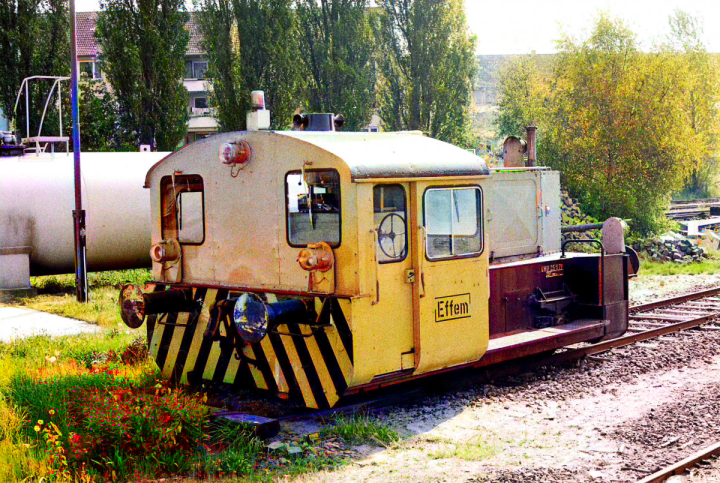
Köf II No. 5231, later 323 049-7 (Deutsche Bundesbahn), owned by Effem GmbH and stabled on one of the sidings at Verden (Aller) Süd. Photo: Dieter Riehemann (colourised by AI).
Once the V36 and the three customer wagons were safely inside Heibo, the Köf could reach the Effem empties standing in the Badenhop standing section (P02).
Köf plus three Effem wagons would measure 331 mm, so the factory locomotive could not pull all three into the 295 mm Ring approach in one movement. The answer was a two-plus-one exchange.
The Köf first coupled to E5, separated E7 from E6 and pulled E5/E6 into the Berliner Ring working approach (P08). It then pushed both wagons into the Effem north ramp (P11), placing E6 deep inside and E5 nearer the entrance.
After clearing the factory turnout, the Köf returned for E7, pulled it into the Berliner Ring working approach (P08) and pushed it against E5.
The final order at the ramp, from south to north, became:
E6—E5—E7
Together, the three wagons occupied 291 mm of the 325 mm ramp length and were ready for loading.
| Movements | Work | RESULT |
|---|---|---|
| M23–M26 | Köf collects E5/E6 from the Badenhop standing section (P02) and places them at the north ramp | Effem north ramp (P11): E6—E5 |
| M27–M30 | Köf returns for E7 and couples it to the pair | Effem north ramp (P11): E6—E5—E7, 291 mm |
| M31–M32 | Köf clears the factory turnout and parks in the holding siding | Köf remains accessible; shared route clear |
Unlike Trial 07A, the Köf had now completed its entire job. It would not handle L1, use the Badenhop loop or enter Löbl.
Berliner Ring Has to be Occupied a Second Time
The same 8 mm problem returned when the V36 was ready to leave Heibo.
L1—B2—B1 stood behind the locomotive towards the buffer stop. To separate L1 from the two Badenhop wagons, the V36 first had to pull the complete 303 mm group out of the siding. Once again, the Berliner Ring working approach (P08) alone was too short.
Movement M33 therefore occupied Berliner Ring for the second time. The V36 pulled into the Berliner Ring working approach (P08) and the extension beyond Berliner Ring (P09), cleared the Heibo turnout and then reversed.
In M34, it pushed the group back towards Badenhop and positioned L1 inside the Badenhop standing section (P02).
The complete locomotive-and-wagon group did not need to fit inside the Badenhop standing section (P02). The route remained continuously set, and no turnout was changed underneath it. Only L1 had to remain secured inside the clearance points after the split.
The order from Badenhop to Ring was now: L1 / B2—B1—V36
The V36 pulled B1/B2 back towards Ring, leaving L1 inside the Badenhop standing section (P02), and then pushed the two wagons into Heibo.
The order in Heibo, from the buffer stop to the siding mouth, became: B2—B1—V36
After uncoupling, the V36 was free to run around L1 through the still-empty Badenhop loop.
| Movements | Work | Result |
|---|---|---|
| M33 | V36+B1+B2+L1 pull from Heibo across Berliner Ring | The complete group clears the Heibo turnout |
| M34 | The group pushes back; L1 is secured and separated inside the Badenhop standing section (P02) | Berliner Ring clears for the second time |
| M35–M36 | V36 pulls B1/B2 away and pushes them into Heibo | B2—B1 remain clear of the main |
| M37–M39 | V36 clears Heibo, runs through the Badenhop loop and couples to L1 from the Badenhop side | V36 reaches the correct end of L1 |
The 110 mm Limit is No Longer the Problem
This was the movement which had stopped the V36 in Trial 07A.
V36 and L1 together measure 123 mm. When Badenhop was the dead end, they could not fit inside the 110 mm western headroom (P01) and clear the turnout. The Köf had to take over because Köf+L1 measured only 103 mm.
With Berliner Ring as the dead end, the western track is no longer a terminal pocket. It is now the continuous connection towards Verden Süd, and the standing convention provides sufficient off-module shunting headroom.
The V36 could therefore pull L1 through the western headroom (P01) and continue beyond the module until the complete 123 mm group had cleared the western turnout. It then reversed and pushed L1 into Löbl siding (P04).
Nothing about the physical 110 mm length had changed.
Its operational meaning had. That is perhaps the clearest example of what turning the module really does. A dimension which forced an exception in one orientation ceases to be a terminal restriction in the other because the track now continues beyond it.
Badenhop Still Has to be Last
Although the orientation had changed, one operating rule had not: Badenhop still had to be served last.
Once L1 stood at Löbl ready for loading, the V36 returned along the clear main, passed the Heibo turnout and reversed into the siding to collect B1/B2.
The complete V36+B1+B2 group measured 240 mm, so it fitted inside the 295 mm Ring approach with 55 mm nominally remaining. The V36 pulled the wagons out of Heibo, reversed and pushed them through the eastern Badenhop access to the ramp.
The final ramp order, read from Badenhop towards Ring, became: B2—B1
This differed from Trial 07A, where the final order was B1—B2. Operationally, both results satisfy the same work order: both loaded vans stand within the 425 mm ramp length, ready for unloading.
Once the vans occupied the ramp, I no longer wanted to depend on the Badenhop loop for another runaround.
The V36 therefore withdrew towards Ring, cleared the eastern turnout, changed direction and returned light to Verden Süd through the Badenhop connection.
| Movements | Work | Result |
|---|---|---|
| M40–M41 | V36 pulls L1 into the off-module western headroom and pushes it into Löbl | L1 ready for loading |
| M42–M45 | V36 clears Löbl, returns via Ring and collects B1/B2 from Heibo | V36+B1/B2 clear of Heibo |
| M46 | V36 pushes both vans to the Badenhop ramp | Badenhop ramp (P10): B2—B1, ready for unloading |
| M47–M49 | V36 withdraws towards Ring, changes direction and returns light to Verden Süd | Main and shared routes clear |
Revised Simulation Movement Record
One row is one uninterrupted movement. Every direction change begins a new row. P-codes are always accompanied by their location descriptions.
Starting State and Work Orders
The module is arranged with Berliner Ring as the dead end. Verden Süd is connected at the Badenhop end.
| Starting location | Wagon order | State | Work order |
|---|---|---|---|
| Effem north ramp (P11), south → north | E1—E2 | Loaded | Collect to Verden Süd |
| Effem holding siding (P07), south → north | E3—E4 | Loaded | Collect to Verden Süd |
| Heibo siding (P05) | Empty | — | — |
| Badenhop ramp (P10) | Empty | — | — |
| Löbl siding (P04) | Empty | — | — |
The inbound transfer is unchanged. Leading to trailing while travelling towards Berliner Ring:
V36—B1—B2—L1—E5—E6—E7
Its physical order from Badenhop to Berliner Ring is therefore:
E7—E6—E5—L1—B2—B1—V36
| Wagon(s) | State | Destination |
|---|---|---|
| B1/B2 | Loaded | Badenhop ramp (P10), ready for unloading |
| L1 | Empty | Löbl siding (P04), ready for loading |
| E5/E6/E7 | Empty | Effem north ramp (P11), ready for loading |
One row is one uninterrupted movement. Every direction change begins a new row. P-codes are always accompanied by their location descriptions.
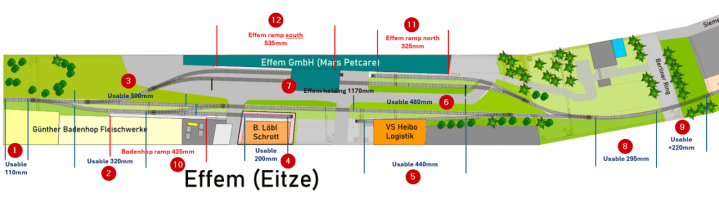
1. Stage and Collect E1/E2 — V36 Visit 1
| MOVE | TRACTION | Movement type and direction | Movement type and direction | MFrom → to | Wagons moved | Action at stop | Track occupation afterwards / routes to keep clear |
|---|---|---|---|---|---|---|---|
| M01 | Köf | Rangierfahrt; locomotive only towards Badenhop | Unattached → north side of E2 | Accessible Effem parking → Effem north ramp (P11) | — | Couple to E2 and confirm E1/E2 coupled. | Effem north ramp (P11), south → north: E1—E2—Köf; shared main clear. |
| M02 | Köf | Rangierfahrt; pulled towards Ring | Ring-side | Effem north ramp (P11) → Berliner Ring working approach (P08) | E1/E2 | Clear the north factory turnout. | Berliner Ring working approach (P08): E1—E2—Köf, 234 mm nominal. |
| M03 | Köf | Rangierfahrt; pushed towards Badenhop | Ring-side | Berliner Ring working approach (P08) → Badenhop standing section (P02) | E1/E2 | Place the pair between both runaround clearance points, secure and uncouple. | Badenhop standing section (P02), Badenhop → Ring: E1—E2; Köf on the Ring side. Keep the Badenhop loop (P03) clear. |
| M04 | Köf | Rangierfahrt; locomotive only towards Ring | Unattached | Badenhop standing section (P02) → Berliner Ring working approach (P08) | — | Withdraw clear of the main standing section and factory turnout. | Badenhop standing section (P02): E1/E2; Berliner Ring working approach (P08): Köf. |
| M05 | Köf | Rangierfahrt; locomotive only towards Badenhop | Unattached | Berliner Ring working approach (P08) → accessible Effem holding position (P07) | — | Park short of E4 and clear of the V36 route. | Effem holding siding (P07): E3—E4 / Köf; Badenhop standing section (P02): E1/E2. |
| M06 | V36 | Zugfahrt; locomotive only towards Ring | Unattached | Verden Süd → Badenhop handover | — | Enter under the session authority. | Badenhop handover: V36; E1/E2 remain secured in the Badenhop standing section (P02). |
| M07 | V36 | Rangierfahrt; locomotive only towards Ring | Unattached → Badenhop-side of E1 | Badenhop handover → Badenhop standing section (P02) | — | Couple to E1. | Badenhop → Ring: V36—E1—E2. |
| M08 | V36 | Rangierfahrt; pulled towards Badenhop | Badenhop-side, leading | Badenhop standing section (P02) → Badenhop handover | E1/E2 | Reach the transfer boundary locomotive-first. | Badenhop handover, leading → trailing: V36—E1—E2; Badenhop standing section (P02) clear. |
| M09 | V36 | Zugfahrt; pulled towards Badenhop | Badenhop-side, leading | Badenhop handover → Verden Süd | E1/E2 | Hand over the loaded pair. | Verden Süd: V36—E1—E2; module routes clear. |
2. Stage and Collect E3/E4 — V36 Visit 2
| Move | Traction | Movement type and direction | Locomotive position | From → to | Wagons moved | Action at stop | Track occupation afterwards / routes to keep clear |
|---|---|---|---|---|---|---|---|
| M10 | Köf | Rangierfahrt; locomotive only towards Badenhop | Unattached → north side of E4 | Accessible Effem holding position (P07) → E3/E4 | — | Couple to E4. | Effem holding siding (P07), south → north: E3—E4—Köf. |
| M11 | Köf | Rangierfahrt; pulled towards Ring | Ring-side | Effem holding siding (P07) → Berliner Ring working approach (P08) | E3/E4 | Clear the north factory turnout. | Berliner Ring working approach (P08): E3—E4—Köf, 234 mm nominal. |
| M12 | Köf | Rangierfahrt; pushed towards Badenhop | Ring-side | Berliner Ring working approach (P08) → Badenhop standing section (P02) | E3/E4 | Place the pair between both clearance points, secure and uncouple. | Badenhop standing section (P02), Badenhop → Ring: E3—E4; Köf on the Ring side. |
| M13 | Köf | Rangierfahrt; locomotive only towards Ring | Unattached | Badenhop standing section (P02) → Berliner Ring working approach (P08) | — | Withdraw clear of the standing section and factory turnout. | Badenhop standing section (P02): E3/E4; Berliner Ring working approach (P08): Köf. |
| M14 | Köf | Rangierfahrt; locomotive only towards Badenhop | Unattached | Berliner Ring working approach (P08) → empty Effem holding siding (P07) | — | Park accessible and clear of the V36 route. | Effem holding siding (P07): Köf; Badenhop standing section (P02): E3/E4. |
| M15 | V36 | Zugfahrt; locomotive only towards Ring | Unattached | Verden Süd → Badenhop handover | — | Enter the module. | Badenhop handover: V36. |
| M16 | V36 | Rangierfahrt; locomotive only towards Ring | Unattached → Badenhop-side of E3 | Badenhop handover → Badenhop standing section (P02) | — | Couple to E3. | Badenhop → Ring: V36—E3—E4. |
| M17 | V36 | Rangierfahrt; pulled towards Badenhop | Badenhop-side, leading | Badenhop standing section (P02) → Badenhop handover | E3/E4 | Reach the transfer boundary locomotive-first. | Badenhop handover, leading → trailing: V36—E3—E4; module stock cleared for delivery. |
| M18 | V36 | Zugfahrt; pulled towards Badenhop | Badenhop-side, leading | Badenhop handover → Verden Süd | E3/E4 | Hand over the loaded pair. | Verden Süd: V36—E3—E4, leading → trailing; loaded E1/E2 and E3/E4 collected; V36 available for the inbound rake. |
3. Receive the Inbound Transfer and Clear the Effem Wagons
| move | Traction | Movement type and direction | Locomotive position | From → to | Wagons moved | Action at stop | Track occupation afterwards / routes to keep clear |
|---|---|---|---|---|---|---|---|
| M19 | V36 | Zugfahrt; pulled towards Ring | Ring-side, leading | Verden Süd → Badenhop handover | B1/B2/L1/E5/E6/E7 | Arrive with the supplied order intact. | Leading → trailing: V36—B1—B2—L1—E5—E6—E7; 594 mm total. |
| M20 | V36 | Rangierfahrt; pulled towards Ring | Ring-side, leading | Badenhop handover → marked continuous receiving position | B1/B2/L1/E5/E6/E7 | Stop with E7/E6/E5 secured inside the Badenhop standing section (P02); uncouple between E5 and L1. | Badenhop → Ring: E7—E6—E5 / L1—B2—B1—V36. The three Effem wagons occupy 291 mm of the Badenhop standing section (P02). |
| M21 | V36 | Rangierfahrt; pulled towards Ring | Ring-side, leading | Receiving position → Berliner Ring working approach (P08) → across Berliner Ring into the extension beyond Berliner Ring (P09) | B1/B2/L1 | Clear the Heibo turnout with the complete group. | Berliner Ring occupied. Berliner Ring working approach (P08) and extension beyond Berliner Ring (P09): L1—B2—B1—V36, 303 mm nominal; Badenhop standing section (P02): E7—E6—E5. |
| M22 | V36 | Rangierfahrt; pushed towards Badenhop | Ring-side | extension beyond Berliner Ring (P09) → Berliner Ring working approach (P08) → Heibo siding (P05) | B1/B2/L1 | Push L1 deep and stop with the complete coupled group inside Heibo and clear of its turnout. | Berliner Ring clear after complete withdrawal. Heibo siding (P05), buffer → mouth: L1—B2—B1—V36, 303 mm within 440 mm. Main and the Berliner Ring working approach (P08) clear. |
| M23 | Köf | Rangierfahrt; locomotive only towards Ring | Unattached | Effem holding siding (P07) → Berliner Ring working approach (P08) | — | Enter the shared route after the V36 group is secured in Heibo. | Heibo siding (P05): L1—B2—B1—V36; Berliner Ring working approach (P08): Köf. |
| M24 | Köf | Rangierfahrt; locomotive only towards Badenhop | Unattached → Ring-side of E5 | Berliner Ring working approach (P08) → Badenhop standing section (P02) | — | Couple E5; secure E7 and separate E7/E6. | Badenhop standing section (P02), Badenhop → Ring: E7 / E6—E5—Köf. |
| M25 | Köf | Rangierfahrt; pulled towards Ring | Ring-side, leading | Badenhop standing section (P02) → Berliner Ring working approach (P08) | E5/E6 | Clear the north factory turnout. | Berliner Ring working approach (P08): E6—E5—Köf, 234 mm nominal; Badenhop standing section (P02): E7. |
| M26 | Köf | Rangierfahrt; pushed towards Badenhop | Ring-side | Berliner Ring working approach (P08) → Effem north ramp (P11) | E5/E6 | Spot E6 deep and E5 nearer the entrance; secure and uncouple. | Effem north ramp (P11), south → north: E6—E5. |
| M27 | Köf | Rangierfahrt; locomotive only towards Ring | Unattached | Effem north ramp (P11) → Berliner Ring working approach (P08) | — | Clear the north factory turnout. | Effem north ramp (P11): E6/E5; Berliner Ring working approach (P08): Köf; Badenhop standing section (P02): E7. |
| M28 | Köf | Rangierfahrt; locomotive only towards Badenhop | Unattached → Ring-side of E7 | Berliner Ring working approach (P08) → Badenhop standing section (P02) | — | Couple to E7. | Badenhop standing section (P02): E7—Köf; the Badenhop loop remains clear. |
| M29 | Köf | Rangierfahrt; pulled towards Ring | Ring-side, leading | Badenhop standing section (P02) → Berliner Ring working approach (P08) | E7 | Clear the north factory turnout. | Berliner Ring working approach (P08): E7—Köf; Badenhop standing section (P02) clear. |
| M30 | Köf | Rangierfahrt; pushed towards Badenhop | Ring-side | Berliner Ring working approach (P08) → Effem north ramp (P11) | E7 | Couple E7 to E5, secure the three empty wagons and uncouple. | Effem north ramp (P11), south → north: E6—E5—E7, 291 mm. |
| M31 | Köf | Rangierfahrt; locomotive only towards Ring | Unattached | Effem north ramp (P11) → Berliner Ring working approach (P08) | — | Clear the north factory turnout. | Effem delivery complete; Berliner Ring working approach (P08): Köf. |
| M32 | Köf | Rangierfahrt; locomotive only towards Badenhop | Unattached | Berliner Ring working approach (P08) → Effem holding siding (P07) | — | Park accessible and clear of the V36 route. | Effem holding siding (P07): Köf; Effem north ramp (P11): E6—E5—E7; V36/B1/B2/L1 remain in the Heibo siding (P05). |
4. Separate L1 and Stage B1/B2 in Heibo
| move | Traction | Movement type and direction | Locomotive position | From → to | Wagons moved | Action at stop | Track occupation afterwards / routes to keep clear |
|---|---|---|---|---|---|---|---|
| M33 | V36 | Rangierfahrt; pulled towards Ring | Ring-side, leading | Heibo siding (P05) → Berliner Ring working approach (P08) → across Berliner Ring into the extension beyond Berliner Ring (P09) | B1/B2/L1 | Clear the Heibo turnout with the complete group. | Berliner Ring occupied. Berliner Ring working approach (P08) and extension beyond Berliner Ring (P09): L1—B2—B1—V36, 303 mm nominal. |
| M34 | V36 | Rangierfahrt; pushed towards Badenhop | Ring-side | extension beyond Berliner Ring (P09) → Berliner Ring working approach (P08) → Badenhop standing section (P02) | B1/B2/L1 | Position L1 inside the Badenhop standing section (P02), secure it and uncouple between L1 and B2. The complete group may remain on the connected route; the eastern turnout is not changed under it. | Berliner Ring clear after complete withdrawal. Badenhop → Ring: L1 / B2—B1—V36; L1 remains within the Badenhop standing section (P02). |
| M35 | V36 | Rangierfahrt; pulled towards Ring | Ring-side, leading | Split position → Berliner Ring working approach (P08) | B1/B2 | Leave L1 secured and clear the Heibo turnout with V36+B1/B2. | Berliner Ring working approach (P08): B2—B1—V36, 240 mm nominal; Badenhop standing section (P02): L1. |
| M36 | V36 | Rangierfahrt; pushed towards Badenhop | Ring-side | Berliner Ring working approach (P08) → Heibo siding (P05) | B1/B2 | Spot B2 deep, secure the pair and uncouple. | Heibo siding (P05), buffer → mouth: B2—B1; V36 at the mouth. Badenhop standing section (P02): L1. |
| M37 | V36 | Rangierfahrt; locomotive only towards Ring | Unattached | Heibo siding (P05) → Berliner Ring working approach (P08) | — | Clear the Heibo turnout. | Heibo siding (P05): B2/B1; Berliner Ring working approach (P08): V36; L1 remains in the Badenhop standing section (P02). |
| M38 | V36 | Rangierfahrt; locomotive only towards Badenhop via the loop | Unattached | Berliner Ring working approach (P08) → eastern Badenhop turnout → Badenhop loop (P03) → western headroom (P01) | — | Run around L1 and clear the western turnout. | Badenhop standing section (P02): L1; western headroom (P01): V36; both loop turnouts available for the next route. |
| M39 | V36 | Rangierfahrt; locomotive only towards Ring | Unattached → Badenhop-side of L1 | Western headroom (P01) → Badenhop standing section (P02) | — | Couple L1 from the Badenhop side. | Badenhop → Ring: V36—L1. |
5. Deliver L1 and B1/B2, then Return to Verden Süd
| MOVE | TRACTION | Movement type and direction | Locomotive position | From → to | Wagons moved | Action at stop | Track occupation afterwards / routes to keep clear |
|---|---|---|---|---|---|---|---|
| M40 | V36 | Rangierfahrt; pulled towards Badenhop | Badenhop-side, leading | Badenhop standing section (P02) → western headroom (P01) → off-module shunting headroom | L1 | Continue until V36+L1 is fully clear of the western turnout. | V36—L1 west of the turnout. The group is not required to fit inside the 110 mm western headroom (P01) limit. |
| M41 | V36 | Rangierfahrt; pushed towards Ring | Badenhop-side | Off-module headroom → western Badenhop route → Löbl siding (P04) | L1 | Spot L1 ready for loading, secure and uncouple. | Löbl siding (P04): L1; V36 on the Badenhop side. |
| M42 | V36 | Rangierfahrt; locomotive only towards Badenhop | Unattached | Löbl siding (P04) → off-module western headroom | — | Clear the western turnout. | Löbl siding (P04): L1; V36 west of the turnout; Badenhop main available. |
| M43 | V36 | Rangierfahrt; locomotive only towards Ring | Unattached | Off-module western headroom → Badenhop main → Berliner Ring working approach (P08) | — | Pass the Heibo turnout and stop clear on its Ring side. | Berliner Ring working approach (P08): V36; Heibo siding (P05): B2—B1. |
| M44 | V36 | Rangierfahrt; locomotive only towards Badenhop | Unattached → Ring-side of B1 | Berliner Ring working approach (P08) → Heibo siding (P05) | — | Couple to B1. | Heibo siding (P05), buffer → mouth: B2—B1—V36. |
| M45 | V36 | Rangierfahrt; pulled towards Ring | Ring-side, leading | Heibo siding (P05) → Berliner Ring working approach (P08) | B1/B2 | Clear the Heibo turnout with the complete group. | Berliner Ring working approach (P08): B2—B1—V36, 240 mm nominal; Heibo siding (P05) clear. |
| M46 | V36 | Rangierfahrt; pushed towards Badenhop | Ring-side | Berliner Ring working approach (P08) → main alongside Heibo (P06) → eastern Badenhop access → Badenhop ramp (P10) | B1/B2 | Spot both loaded vans ready for unloading, secure and uncouple. | Badenhop ramp (P10), Badenhop → Ring: B2—B1; V36 on the Ring side. Badenhop runaround is no longer required. |
| M47 | V36 | Rangierfahrt; locomotive only towards Ring | Unattached | Badenhop ramp (P10) → main → Berliner Ring working approach (P08) | — | Withdraw clear of the eastern Badenhop turnout. | Badenhop ramp (P10): B2/B1; Berliner Ring working approach (P08): V36; main route west can now be set. |
| M48 | V36 | Rangierfahrt; locomotive only towards Badenhop | Unattached | Berliner Ring working approach (P08) → Badenhop handover | — | Reach the transfer boundary and report the module route clear. | Badenhop handover: V36; main and shared approaches clear. |
| M49 | V36 | Zugfahrt; locomotive only towards Badenhop | Unattached | Badenhop handover → Verden Süd | — | Complete the light departure. | Verden Süd: V36 returned light; E1/E2 and E3/E4 already collected. Köf accessible in the Effem holding siding (P07). |
End State
| Location | Final wagon order | State / result |
|---|---|---|
| Effem north ramp (P11), south → north | E6—E5—E7 | Three empties ready for loading |
| Effem holding siding (P07) | No wagons; Köf parked clear | Köf accessible and ready for work |
| Heibo siding (P05) | Empty | Available again |
| Badenhop ramp (P10), Badenhop → Ring | B2—B1 | Two loaded vans ready for unloading |
| Löbl siding (P04) | L1 | Empty, ready for loading |
| Verden Süd | E1/E2 and E3/E4 | Four loaded Effem wagons collected; V36 returned light |
| Main and shared approaches | Clear | Session complete |
All ten wagon IDs are accounted for once. No wagon changes load state during the session.
Comparing the Simulations
Looking only at the total, turning the module around appears to save two movements.
That is correct—but it does not explain what really changed.
| Measure | Trial 07A: Badenhop dead end | Trial 07B: Berliner Ring dead end |
|---|---|---|
| Numbered movements | 51 | 49 |
| V36 visits | 3 | 3 |
| Transfer legs | 6 | 6 |
| V36 movements | 20 | 29 |
| Köf movements | 31 | 20 |
| V36 runarounds through Badenhop | 1 | 1 |
| Köf runarounds through Badenhop | 1 | 0 |
| Berliner Ring occupation episodes | 1 | 2 |
| Köf authorised to serve Löbl | Required | Not required |
| Effem south entrance uses | 0 | 0 |
| Final Effem order, south → north | E6—E7—E5 | E6—E5—E7 |
| Final Badenhop order, Badenhop → Ring | B1—B2 | B2—B1 |
The Köf makes eleven fewer movements because it no longer has to take L1 across Berliner Ring, bring it back, run around it through Badenhop and deliver it to Löbl.
The V36 makes nine more movements because that work has not disappeared. It has simply moved to the VWE locomotive.
The V36 must separate L1 from the two wagons, stage B1/B2 in Heibo, run around L1, serve Löbl, return to Heibo, collect the vans and finally withdraw from Badenhop before departing.
The total falls by only two movements because Trial 07B is not simply more efficient. It distributes the work differently.
That distinction matters during a FREMO session. Fewer movements do not automatically mean a lighter job for every crew. Trial 07B keeps the Effem operator’s work more focused, but gives the VWE crew a longer local shunting sequence and occupies Berliner Ring twice.
Which Arrangement Do I Prefer?
The movement total does not give me a clear winner—and that is probably the most interesting result.
With Badenhop as the dead end, the 110 mm headroom creates the sharper puzzle. The Köf has to step outside its normal role, while two independent holding positions—Köf+L1 beyond Berliner Ring and V36+B1/B2 inside Heibo—must be preserved at the same time.
With Berliner Ring as the dead end, the locomotive duties remain cleaner. The Köf handles only Effem traffic, while the V36 serves Badenhop and Löbl as intended. The price is more work for the V36 crew and two deliberate occupations of the Berliner Ring road crossing.
I would therefore not choose between the two arrangements simply by comparing 51 with 49 movements.
Instead, I would ask what sort of operating job I want from that session:
- Trial 07A gives the Köf crew the more unusual and demanding assignment.
- Trial 07B gives the V36 crew the longer local shunting job.
- Trial 07A depends on the 7 mm nominal clearance of Köf+L1 at the Badenhop end.
- Trial 07B depends on two protected occupations of Berliner Ring and a marked receiving position for the 594 mm inbound train.
- Both arrangements require Badenhop to remain available until the final runaround has been completed.
That tells me much more than simply declaring one sequence the winner.
What I Still Have to Test on the Real Module
The simulation has narrowed the physical test down to a small number of very specific movements.
As with Trial 07A, this remains a tabletop simulation until the sequence has been tried with the actual locomotives, wagons and couplers.
- E1/E2 and E3/E4 must stand inside the Badenhop clearance points (P02) and remain accessible to the V36 from the connected end.
- The 594 mm inbound train needs a marked stopping position which leaves E7/E6/E5 completely inside the Badenhop standing section (P02) without occupying Berliner Ring.
- V36+B1+B2+L1 must clear the Heibo turnout through the Berliner Ring working approach (P08) and the extension beyond Berliner Ring (P09) during movements M21 and M33.
- The complete 303 mm V36+B1+B2+L1 group must stand clear inside Heibo after M22.
- L1 must remain safely inside the Badenhop standing section (P02) during the split in M34, while V36+B1/B2 pull back towards Ring without a turnout being changed underneath the group.
- The connected western headroom must allow V36+L1 to clear the turnout before L1 is pushed into Löbl during M40–M41.
- B1/B2 must reach the Badenhop ramp through the eastern access in M46, with enough room for the V36 to withdraw afterwards.
- The FREMO arrangement must define who authorises and protects the two occupations of Berliner Ring.
The paper simulation has already done its job. It has shown me where the stopping marks are needed and which movements deserve particular attention during the physical test.
The Same Timesaver, but a Different Operating Day
Nothing in Trial 07B required another turnout, an additional siding or a different wagon fleet.
I only connected Verden Süd at the opposite end.
Yet the whole character of the session changed.
In Trial 07A, seven millimetres allowed the Köf to solve a problem which stopped the V36. In Trial 07B, the same 110 mm track ceased to be the controlling limit because it became part of the continuous route towards Verden Süd.
The new restriction appeared at the other end, where the 303 mm V36+B1+B2+L1 group exceeded the normal Berliner Ring limit by eight millimetres.
That is what I enjoy about operating Effem as a Timesaver. The challenge does not come from an artificial rule. It comes from the relationship between wagon order, locomotive position, usable length and the route needed after the present movement.
Turn the module around, and the railway asks a different question.
DEUTSCHE VERSION
Verden-Walsroder Eisenbahn (VWE): Der Effem Timesaver – einmal andersherum (Teil 2)
In meinem vorherigen Beitrag über den Effem Timesaver habe ich eine vollständige Betriebssession durchgespielt. Dabei war Badenhop das Stumpfende, während Verden Süd über Berliner Ring angeschlossen war.
Diese erste Simulation – Versuch 07A – ergab einen funktionierenden Ablauf mit 51 Bewegungen. Gleichzeitig zeigte sie, warum die Effem-Köf II ihren normalen Werksdienst verlassen und den leeren offenen Wagen L1 nach Löbl bringen musste: V36 und L1 waren zusammen 13 mm zu lang für den nur 110 mm langen westlichen Ausziehbereich.
Damit stellte sich fast automatisch die nächste Frage:
Was passiert, wenn ich das Modul anders herum anschließe?
In Versuch 07B liegt Verden Süd nun auf der Badenhop-Seite, während Berliner Ring zum Stumpfende wird. Alles andere bleibt unverändert: dieselben Lokomotiven, dieselben zehn Wagen, dieselben Beladungszustände und genau dieselben Arbeitsaufträge.
Zunächst dachte ich, ich müsste die bisherigen Rangierbewegungen einfach nur in umgekehrter Richtung ausführen.
So einfach war es natürlich nicht.
Die neue Session kommt zwar mit zwei Bewegungen weniger aus. Viel interessanter ist aber, wie sich die Arbeit verteilt: Die Köf hat deutlich weniger zu tun, die V36 dafür wesentlich mehr – und der Bahnübergang Berliner Ring muss zweimal statt nur einmal belegt werden.
Genau deshalb entsteht durch das Drehen des Moduls keine spiegelverkehrte Wiederholung, sondern eine ganz neue Timesaver-Aufgabe.
Dieselben Wagen, aber der Anschluss am anderen Ende
Die Ausgangslage blieb gegenüber Versuch 07A unverändert.
| Startposition | Wagenreihung | Zustand | Arbeitsauftrag |
|---|---|---|---|
| Effem-Nordrampe (P11), Süd → Nord | E1—E2 | beladen | nach Verden Süd abholen |
| Effem-Abstellgleis (P07), Süd → Nord | E3—E4 | beladen | nach Verden Süd abholen |
| Heibo-Anschlussgleis (P05) | leer | — | — |
| Badenhop-Rampe (P10) | leer | — | — |
| Löbl-Anschlussgleis (P04) | leer | — | — |
Auch die ankommende Übergabe blieb gleich. Von der Zugspitze zum Zugschluss, in Fahrtrichtung Berliner Ring, lautete die Reihung:
V36—B1—B2—L1—E5—E6—E7
B1 und B2 waren beladene Kühlwagen für Badenhop. L1 war ein leerer offener Wagen für Löbl. E5, E6 und E7 waren leere Schiebewandwagen für Effem. Die gesamte Übergabe war weiterhin 594 mm lang.
Geändert hatte sich jedoch die tatsächliche Reihenfolge auf dem Modul. Da der Zug nun von Badenhop in Richtung Berliner Ring fuhr, lautete die geografische Reihung von Badenhop nach Ring:
E7—E6—E5—L1—B2—B1—V36
Die Effem-Wagen befanden sich damit am Badenhop-Ende des Zuges und nicht mehr am frei zugänglichen Ring-Ende. Die Köf konnte also nicht mehr einfach hinter E7 heranfahren und die Übergabe vom Zugschluss her zerlegen.
Diese eine Änderung bestimmte fast den gesamten weiteren Ablauf.
Zuerst die abgehenden Effem-Wagen – diesmal über Badenhop
Die erste Aufgabe bestand darin, die V36 für die Rückfahrt nach Verden Süd auf die richtige Seite der vier beladenen Effem-Wagen zu bringen.
Wie zuvor mussten diese Wagen das Modul verlassen, bevor die ankommenden Leerwagen an der Nordrampe bereitgestellt werden konnten. In Versuch 07A hatte die Köf jedes Wagenpaar nach Heibo gebracht, wo es die V36 von der Ring-Seite aus abholte.
Bei der neuen Modulausrichtung hätte die V36 danach jedoch am falschen Ende für die Fahrt nach Verden Süd gestanden.
Die bessere Lösung war deshalb, den 320 mm langen Badenhop-Aufstellabschnitt (P02) vorübergehend als Übergabepunkt zu nutzen.
Die Köf zog zunächst E1/E2 von der Nordrampe in den 295 mm langen Rangierbereich vor Berliner Ring (P08). Köf und zwei Effem-Wagen waren zusammen 234 mm lang und blieben damit vollständig diesseits des Bahnübergangs.
Anschließend wechselte die Köf die Fahrtrichtung und schob das Wagenpaar in den Badenhop-Aufstellabschnitt (P02). Die beiden Wagen belegten dort 194 mm und standen vollständig zwischen den beiden Grenzzeichen der Umfahrung.
Danach zog sich die Köf wieder nach Effem zurück und gab den Badenhop-Fahrweg frei. Die V36 kam allein aus Verden Süd, kuppelte E1 von der Badenhop-Seite an und zog das Wagenpaar direkt zurück zum Übergabepunkt.
Mit E3/E4 wurde derselbe Ablauf wiederholt.
Ein Umsetzen der V36 war nicht erforderlich. Durch das Bereitstellen der Wagen im Badenhop-Aufstellabschnitt (P02) erreichte die V36 sie bereits von der richtigen Seite und konnte sie lokbespannt an der Spitze nach Verden Süd bringen.
Mit den ersten 18 Bewegungen waren damit alle vier abgehenden Effem-Wagen in zwei V36-Besuchen abgeholt:
| Bewegungen | Arbeit | Ergebnis |
|---|---|---|
| M01–M09 | Köf stellt E1/E2 im Badenhop-Aufstellabschnitt (P02) bereit; V36 übernimmt das Paar von der Badenhop-Seite | V36—E1—E2 erreicht Verden Süd |
| M10–M18 | Derselbe Ablauf wird mit E3/E4 wiederholt | V36—E3—E4 erreicht Verden Süd |
Die Kundenanschlüsse Badenhop und Löbl blieben weiterhin leer. Auch die Badenhop-Umfahrung (P03) stand für das später notwendige Umsetzen zur Verfügung.
Die ankommende Übergabe passt – die nächste Gruppe ist 8 mm zu lang
Die 594 mm lange Übergabe selbst war nicht das Problem.
Sie musste nicht vollständig in ein einzelnes Ausziehgleis passen. Die V36 fuhr über die durchgehende Verbindung von Verden Süd ein und hielt an einer festgelegten Empfangsposition.
Entscheidend war, E7/E6/E5 vollständig innerhalb des 320 mm langen Badenhop-Aufstellabschnitts (P02) abzustellen.
Die drei Effem-Wagen waren zusammen 291 mm lang. Damit blieben nominell 29 mm Reserve. Ich konnte sie also innerhalb beider Grenzzeichen sichern und zwischen E5 und L1 abkuppeln.
An der V36 verblieben B1, B2 und L1. Diese Gruppe war insgesamt 303 mm lang.
Und genau hier entstand das erste neue Problem.
Vor Berliner Ring stehen normalerweise nur 295 mm Rangierlänge zur Verfügung. Der V36-Gruppe fehlten also lediglich 8 mm, um vollständig in den Rangierbereich vor Berliner Ring (P08) zu passen und die Heibo-Weiche freizufahren.
Aber 8 mm zu viel sind eben trotzdem zu viel.
Die Lösung erforderte eine ausdrückliche Erlaubnis, den Bahnübergang Berliner Ring zu belegen und die zusätzlichen 220 mm hinter der Straße (P09) zu nutzen. Zusammen ergeben der Rangierbereich vor Berliner Ring (P08) und das Zusatzgleis hinter Berliner Ring (P09) eine durchgehende Nutzlänge von 515 mm bis zum Effem-Modulende.
| BewegungEN | ARBEIT | ERGEBNIS |
|---|---|---|
| M19–M20 | Die vollständige Übergabe fährt ein; E7/E6/E5 werden innerhalb des Badenhop-Aufstellabschnitts (P02) gesichert | Die Effem-Wagen werden ohne Änderung ihres Beladungszustands abgetrennt |
| M21 | V36+B1+B2+L1 ziehen über Berliner Ring bis ins Zusatzgleis hinter Berliner Ring (P09) | Die 303 mm lange Gruppe fährt die Heibo-Weiche vollständig frei |
| M22 | Die V36 wechselt die Fahrtrichtung und schiebt die gesamte Gruppe nach Heibo (P05) | Berliner Ring wird geräumt; Hauptgleis und Rangierbereich vor Berliner Ring (P08) stehen wieder der Köf zur Verfügung |
Heibo verfügt über 440 mm Nutzlänge. V36+B1+B2+L1 belegten davon 303 mm, sodass nominell noch 137 mm übrig blieben.
Die vollständige gekuppelte Gruppe konnte damit grenzzeichenfrei im Anschluss stehen.
Genau diese Abstellmöglichkeit machte den weiteren Ablauf möglich.
Die Köf kann sich jetzt ausschließlich um Effem kümmern
Köf II Nr. 5231 (später 323 049-7 DB) der Effem GmbH, abgestellt auf einem Anschlussgleis in Verden (Aller) Süd. Foto: Dieter Riehemann (KI-koloriert).
Sobald die V36 mit den drei Kundenwagen vollständig in Heibo stand, konnte die Köf die drei Effem-Leerwagen im Badenhop-Aufstellabschnitt (P02) erreichen.
Köf und drei Effem-Wagen wären zusammen 331 mm lang gewesen. Damit konnte die Werkslok nicht alle drei Wagen gleichzeitig in den 295 mm langen Ring-Bereich ziehen.
Die Lösung war deshalb wieder eine Zwei-plus-eins-Zustellung.
Zunächst kuppelte die Köf an E5, sicherte E7 und trennte zwischen E7 und E6. Danach zog sie E5/E6 in den Rangierbereich vor Berliner Ring (P08) und schob beide Wagen an die Effem-Nordrampe (P11). E6 stand tief im Rampengleis, E5 näher an der Einfahrt.
Nachdem die Köf die Werksweiche wieder freigefahren hatte, kehrte sie zu E7 zurück, zog den einzelnen Wagen ebenfalls in den Rangierbereich vor Berliner Ring (P08) und schob ihn anschließend an E5.
Die endgültige Wagenreihung an der Nordrampe, von Süd nach Nord, lautete:
E6—E5—E7
Zusammen belegten die drei Wagen 291 mm der 325 mm langen Rampe und standen zum Beladen bereit.
| Bewegungen | Arbeit | Ergebnis |
|---|---|---|
| M23–M26 | Köf holt E5/E6 aus dem Badenhop-Aufstellabschnitt (P02) und stellt beide Wagen an der Nordrampe bereit | Effem-Nordrampe (P11): E6—E5 |
| M27–M30 | Köf kehrt zu E7 zurück und stellt ihn an das bereits abgestellte Paar | Effem-Nordrampe (P11): E6—E5—E7, 291 mm |
| M31–M32 | Köf fährt die Werksweiche frei und wird im Effem-Abstellgleis abgestellt | Köf bleibt erreichbar; gemeinsam genutzter Fahrweg frei |
Anders als in Versuch 07A war die Arbeit der Köf damit vollständig erledigt.
Sie musste weder L1 übernehmen noch die Badenhop-Umfahrung benutzen oder in den Löbl-Anschluss fahren.
Berliner Ring muss ein zweites Mal belegt werden
Als die V36 Heibo wieder verlassen sollte, kehrte dasselbe 8-mm-Problem zurück.
L1—B2—B1 standen hinter der Lok in Richtung Gleisende. Um L1 von den beiden Badenhop-Wagen zu trennen, musste die V36 zunächst die vollständige, 303 mm lange Gruppe aus Heibo herausziehen.
Der Rangierbereich vor Berliner Ring (P08) allein war dafür erneut zu kurz.
Mit Bewegung M33 wurde Berliner Ring deshalb ein zweites Mal belegt. Die V36 zog die Gruppe in den Rangierbereich vor Berliner Ring (P08) und weiter bis ins Zusatzgleis hinter Berliner Ring (P09), fuhr die Heibo-Weiche vollständig frei und wechselte anschließend die Fahrtrichtung.
In M34 schob sie die Wagen wieder in Richtung Badenhop zurück und stellte L1 innerhalb des Badenhop-Aufstellabschnitts (P02) ab.
Dabei musste nicht die gesamte Lok-Wagen-Gruppe im Badenhop-Aufstellabschnitt (P02) stehen. Der Fahrweg blieb durchgehend eingestellt, und unter der Gruppe wurde keine Weiche umgestellt. Nach dem Trennen musste lediglich L1 sicher zwischen den beiden Grenzzeichen stehen.
Die geografische Reihenfolge von Badenhop nach Ring lautete nun: L1 / B2—B1—V36
Die V36 zog B1/B2 wieder in Richtung Ring und ließ L1 im Badenhop-Aufstellabschnitt (P02) zurück. Anschließend schob sie die beiden Kühlwagen nach Heibo.
Dort ergab sich vom Gleisende zur Weiche folgende Reihenfolge: B2—B1—V36
Nach dem Abkuppeln konnte die V36 L1 über die weiterhin freie Badenhop-Umfahrung umfahren.
| Bewegung | Arbeit | Ergebnis |
|---|---|---|
| M33 | V36+B1+B2+L1 ziehen aus Heibo über Berliner Ring | Die vollständige Gruppe fährt die Heibo-Weiche frei |
| M34 | Die Gruppe schiebt zurück; L1 wird innerhalb des Badenhop-Aufstellabschnitts (P02) gesichert und abgetrennt | Berliner Ring wird zum zweiten Mal geräumt |
| M35–M36 | V36 zieht B1/B2 von L1 weg und schiebt beide Wagen nach Heibo | B2—B1 stehen außerhalb des Hauptgleises |
| M37–M39 | V36 fährt Heibo frei, umfährt L1 über Badenhop und kuppelt von der Badenhop-Seite an | V36 steht am richtigen Ende von L1 |
Die 110 mm sind nicht mehr das Problem
Genau diese Bewegung war in Versuch 07A mit der V36 nicht möglich gewesen.
V36 und L1 sind zusammen 123 mm lang. Als Badenhop das Stumpfende war, passte diese Gruppe nicht in den lediglich 110 mm langen westlichen Ausziehbereich (P01). Um die Weiche umstellen zu können, musste deshalb die kürzere Köf übernehmen. Köf und L1 waren zusammen nur 103 mm lang.
Mit Berliner Ring als Stumpfende ist das westliche Gleis jedoch keine kurze Ausziehstrecke mehr. Es bildet jetzt die durchgehende Verbindung in Richtung Verden Süd. Nach der festgelegten Betriebskonvention steht außerhalb des Moduls ausreichend Rangierraum zur Verfügung.
Die V36 konnte L1 durch den westlichen Ausziehbereich (P01) hindurchziehen und über das Modulende hinausfahren, bis die vollständige, 123 mm lange Gruppe die westliche Weiche freigefahren hatte.
Danach wechselte sie die Fahrtrichtung und schob L1 in den Löbl-Anschluss (P04).
An der tatsächlichen Länge von 110 mm hatte sich nichts geändert.
Verändert hatte sich ihre betriebliche Bedeutung.
Das zeigt für mich besonders deutlich, was das Drehen des Moduls bewirkt: Eine Länge, die in der einen Anordnung eine Ausnahme erforderlich macht, ist in der anderen kein begrenzender Ausziehbereich mehr, weil das Gleis dort über das Modul hinaus weiterführt.
Badenhop muss trotzdem bis zum Schluss frei bleiben
Obwohl sich die Modulausrichtung geändert hatte, blieb eine Betriebsregel bestehen: Badenhop musste als Letztes bedient werden.
Nachdem L1 bei Löbl zum Beladen bereitstand, fuhr die V36 über das freie Hauptgleis zurück. Sie passierte die Heibo-Weiche, wechselte die Fahrtrichtung und kuppelte im Anschluss an B1/B2.
Die vollständige Gruppe aus V36 und den beiden Badenhop-Wagen war 240 mm lang. Sie passte damit in den 295 mm langen Rangierbereich vor Berliner Ring und ließ nominell noch 55 mm Reserve.
Die V36 zog die Wagen aus Heibo, wechselte erneut die Fahrtrichtung und schob sie über die östliche Badenhop-Zufahrt an die Rampe.
Die endgültige Wagenreihung von Badenhop nach Ring lautete: B2—B1
In Versuch 07A war die Reihenfolge am Ende B1—B2 gewesen. Betrieblich erfüllen beide Ergebnisse denselben Arbeitsauftrag: Beide beladenen Kühlwagen stehen innerhalb der 425 mm langen Rampenposition und sind zum Entladen bereit.
Sobald die Wagen an der Rampe standen, wollte ich nicht mehr auf die Badenhop-Umfahrung angewiesen sein.
Die V36 zog deshalb wieder in Richtung Ring, fuhr die östliche Weiche frei, wechselte die Fahrtrichtung und kehrte anschließend allein über den Badenhop-Anschluss nach Verden Süd zurück.
Bewegungsprotokoll
Eine Zeile entspricht genau einer ununterbrochenen Bewegung. Jeder Richtungswechsel beginnt eine neue Zeile. M01, M02 … bezeichnen Bewegungen; P01, P02 … bezeichnen Positionen im Gleisplan. Jeder P-Code wird zusammen mit seiner Ortsbeschreibung verwendet.
Ausgangslage und Arbeitsauftrag
Das Modul ist mit Berliner Ring als Stumpfende aufgebaut; Verden Süd ist über die Badenhopseite angeschlossen.
| Startposition | Wagenreihung | Zustand | Arbeitsauftrag |
|---|---|---|---|
| Effem-Nordrampe (P11), Süd → Nord | E1—E2 | Beladen | Nach Verden Süd abholen |
| Effem-Abstellgleis (P07), Süd → Nord | E3—E4 | Beladen | Nach Verden Süd abholen |
| Heibo-Anschlussgleis (P05) | Leer | — | — |
| Badenhop-Rampe (P10) | Leer | — | — |
| Löbl-Anschlussgleis (P04) | Leer | — | — |
Die ankommende Übergabe ist in Fahrtrichtung Berliner Ring von der Spitze zum Schluss gereiht:
V36—B1—B2—L1—E5—E6—E7
Ihre geografische Reihenfolge auf dem Modul, gelesen von Badenhop nach Berliner Ring, lautet damit:
E7—E6—E5—L1—B2—B1—V36
| Wagen | Zustand | Ziel |
|---|---|---|
| B1/B2 | Beladen | Badenhop-Rampe (P10), zur Entladung bereit |
| L1 | Leer | Löbl-Anschlussgleis (P04), zur Beladung bereit |
| E5/E6/E7 | Leer | Effem-Nordrampe (P11), zur Beladung bereit |
1. E1/E2 bereitstellen und abholen – V36-Besuch 1
| BEW. | Traktion | Bewegungsart und Richtung | Position der Lok | Von → nach | Bewegte Wagen | Handlung am Haltepunkt | Gleisbelegung danach / freizuhaltende Fahrwege |
|---|---|---|---|---|---|---|---|
| M01 | Köf | Rangierfahrt; Lok allein Richtung Badenhop | Ungekuppelt → Nordseite von E2 | Zugänglicher Effem-Abstellplatz → Effem-Nordrampe (P11) | — | An E2 ankuppeln und prüfen, dass E1/E2 miteinander gekuppelt sind. | Effem-Nordrampe (P11), Süd → Nord: E1—E2—Köf; gemeinsam genutztes Streckengleis frei. |
| M02 | Köf | Rangierfahrt; gezogen Richtung Ring | Ringseite | Effem-Nordrampe (P11) → Rangierbereich vor Berliner Ring (P08) | E1/E2 | Nördliche Werksweiche vollständig freifahren. | Rangierbereich vor Berliner Ring (P08): E1—E2—Köf, nominell 234 mm. |
| M03 | Köf | Rangierfahrt; geschoben Richtung Badenhop | Ringseite | Rangierbereich vor Berliner Ring (P08) → Badenhop-Aufstellabschnitt (P02) | E1/E2 | Das Wagenpaar zwischen beiden Grenzzeichen abstellen, sichern und die Köf abkuppeln. | Badenhop-Aufstellabschnitt (P02), Badenhop → Ring: E1—E2; Köf auf der Ringseite. Badenhop-Umfahrgleis (P03) freihalten. |
| M04 | Köf | Rangierfahrt; Lok allein Richtung Ring | Ungekuppelt | Badenhop-Aufstellabschnitt (P02) → Rangierbereich vor Berliner Ring (P08) | — | Badenhop-Aufstellabschnitt und nördliche Werksweiche vollständig freifahren. | Badenhop-Aufstellabschnitt (P02): E1/E2; Rangierbereich vor Berliner Ring (P08): Köf. |
| M05 | Köf | Rangierfahrt; Lok allein Richtung Badenhop | Ungekuppelt | Rangierbereich vor Berliner Ring (P08) → Effem-Abstellgleis (P07) | — | Vor E4 sowie außerhalb des Fahrwegs der V36 erreichbar abstellen. | Effem-Abstellgleis (P07): E3—E4 / Köf; Badenhop-Aufstellabschnitt (P02): E1/E2. |
| M06 | V36 | Zugfahrt; Lok allein Richtung Ring | Ungekuppelt | Verden Süd → Übergabepunkt Badenhopseite | — | Mit der für die Session vereinbarten Zustimmung in das Modul einfahren. | Übergabepunkt Badenhopseite: V36; E1/E2 bleiben gesichert im Badenhop-Aufstellabschnitt (P02). |
| M07 | V36 | Rangierfahrt; Lok allein Richtung Ring | Ungekuppelt → Badenhopseite von E1 | Übergabepunkt Badenhopseite → Badenhop-Aufstellabschnitt (P02) | — | An E1 ankuppeln. | Streckengleis, Badenhop → Ring: V36—E1—E2. |
| M08 | V36 | Rangierfahrt; gezogen Richtung Badenhop | Badenhopseite, führend | Badenhop-Aufstellabschnitt (P02) → Übergabepunkt Badenhopseite | E1/E2 | Den Übergabepunkt mit der Lok an der Spitze erreichen. | Übergabepunkt Badenhopseite, Spitze → Schluss: V36—E1—E2; Badenhop-Aufstellabschnitt (P02) frei. |
| M09 | V36 | Zugfahrt; gezogen Richtung Badenhop | Badenhopseite, führend | Übergabepunkt Badenhopseite → Verden Süd | E1/E2 | Beladenes Wagenpaar übergeben. | Verden Süd: V36—E1—E2, Reihung von Spitze → Schluss; E1/E2 beladen und übergeben; alle Fahrwege auf dem Modul frei. |
2. E3/E4 bereitstellen und abholen – V36-Besuch 2
| BEW. | Traktion | Bewegungsart und Richtung | Position der Lok | Von → nach | Bewegte Wagen | Handlung am Haltepunkt | Gleisbelegung danach / freizuhaltende Fahrwege |
|---|---|---|---|---|---|---|---|
| M10 | Köf | Rangierfahrt; Lok allein Richtung Badenhop | Ungekuppelt → Nordseite von E4 | Abstellplatz im Effem-Abstellgleis (P07) → E3/E4 im Effem-Abstellgleis (P07) | — | An E4 ankuppeln. | Effem-Abstellgleis (P07), Süd → Nord: E3—E4—Köf. |
| M11 | Köf | Rangierfahrt; gezogen Richtung Ring | Ringseite | Effem-Abstellgleis (P07) → Rangierbereich vor Berliner Ring (P08) | E3/E4 | Nördliche Werksweiche vollständig freifahren. | Rangierbereich vor Berliner Ring (P08): E3—E4—Köf, nominell 234 mm. |
| M12 | Köf | Rangierfahrt; geschoben Richtung Badenhop | Ringseite | Rangierbereich vor Berliner Ring (P08) → Badenhop-Aufstellabschnitt (P02) | E3/E4 | Das Wagenpaar zwischen beiden Grenzzeichen abstellen, sichern und die Köf abkuppeln. | Badenhop-Aufstellabschnitt (P02), Badenhop → Ring: E3—E4; Köf auf der Ringseite. |
| M13 | Köf | Rangierfahrt; Lok allein Richtung Ring | Ungekuppelt | Badenhop-Aufstellabschnitt (P02) → Rangierbereich vor Berliner Ring (P08) | — | Badenhop-Aufstellabschnitt und nördliche Werksweiche vollständig freifahren. | Badenhop-Aufstellabschnitt (P02): E3/E4; Rangierbereich vor Berliner Ring (P08): Köf. |
| M14 | Köf | Rangierfahrt; Lok allein Richtung Badenhop | Ungekuppelt | Rangierbereich vor Berliner Ring (P08) → freies Effem-Abstellgleis (P07) | — | Erreichbar und außerhalb des Fahrwegs der V36 abstellen. | Effem-Abstellgleis (P07): Köf; Badenhop-Aufstellabschnitt (P02): E3/E4. |
| M15 | V36 | Zugfahrt; Lok allein Richtung Ring | Ungekuppelt | Verden Süd → Übergabepunkt Badenhopseite | — | In das Modul einfahren. | Übergabepunkt Badenhopseite: V36. |
| M16 | V36 | Rangierfahrt; Lok allein Richtung Ring | Ungekuppelt → Badenhopseite von E3 | Übergabepunkt Badenhopseite → Badenhop-Aufstellabschnitt (P02) | — | An E3 ankuppeln. | Streckengleis, Badenhop → Ring: V36—E3—E4. |
| M17 | V36 | Rangierfahrt; gezogen Richtung Badenhop | Badenhopseite, führend | Badenhop-Aufstellabschnitt (P02) → Übergabepunkt Badenhopseite | E3/E4 | Den Übergabepunkt mit der Lok an der Spitze erreichen. | Übergabepunkt Badenhopseite, Spitze → Schluss: V36—E3—E4; Ausgangswagen vom Modul entfernt, Zustellfahrwege frei. |
| M18 | V36 | Zugfahrt; gezogen Richtung Badenhop | Badenhopseite, führend | Übergabepunkt Badenhopseite → Verden Süd | E3/E4 | Beladenes Wagenpaar übergeben. | Verden Süd: V36—E3—E4, Reihung von Spitze → Schluss; E1/E2 und E3/E4 beladen abgeholt; V36 für die Eingangswagen verfügbar. |
3. Die ankommende Übergabe übernehmen und E5/E6/E7 zustellen
| BEW. | Traktion | Bewegungsart und Richtung | Position der Lok | Von → nach | Bewegte Wagen | Handlung am Haltepunkt | Gleisbelegung danach / freizuhaltende Fahrwege |
|---|---|---|---|---|---|---|---|
| M19 | V36 | Zugfahrt; gezogen Richtung Ring | Ringseite, führend | Verden Süd → Übergabepunkt Badenhopseite | B1/B2/L1/E5/E6/E7 | Mit der vorgegebenen Wagenreihung einfahren. | Spitze → Schluss: V36—B1—B2—L1—E5—E6—E7; Gesamtlänge 594 mm. |
| M20 | V36 | Rangierfahrt; gezogen Richtung Ring | Ringseite, führend | Übergabepunkt Badenhopseite → markierte durchgehende Einfahrposition | B1/B2/L1/E5/E6/E7 | So halten, dass E7/E6/E5 vollständig im Badenhop-Aufstellabschnitt (P02) stehen; zwischen E5 und L1 abkuppeln. | Badenhop → Ring: E7—E6—E5 / L1—B2—B1—V36. Die drei Effem-Wagen belegen 291 mm im Badenhop-Aufstellabschnitt (P02). |
| M21 | V36 | Rangierfahrt; gezogen Richtung Ring | Ringseite, führend | Einfahrposition → Rangierbereich vor Berliner Ring (P08) → über Berliner Ring → Zusatzgleis hinter Berliner Ring (P09) | B1/B2/L1 | Mit dem vollständigen Verband die Heibo-Weiche freifahren. | Berliner Ring belegt. Rangierbereich vor Berliner Ring (P08) und Zusatzgleis hinter Berliner Ring (P09): L1—B2—B1—V36, nominell 303 mm; Badenhop-Aufstellabschnitt (P02): E7—E6—E5. |
| M22 | V36 | Rangierfahrt; geschoben Richtung Badenhop | Ringseite | Zusatzgleis hinter Berliner Ring (P09) → Rangierbereich vor Berliner Ring (P08) → Heibo-Anschlussgleis (P05) | B1/B2/L1 | L1 tief im Gleis abstellen und den vollständigen Verband innerhalb Heibo sowie frei von der Anschlussweiche zum Stehen bringen. | Berliner Ring frei, nachdem die Gruppe den Bahnübergang vollständig geräumt hat. Heibo-Anschlussgleis (P05), Gleisende → Weiche: L1—B2—B1—V36, 303 mm innerhalb von 440 mm. Streckengleis und Rangierbereich vor Berliner Ring (P08) frei. |
| M23 | Köf | Rangierfahrt; Lok allein Richtung Ring | Ungekuppelt | Effem-Abstellgleis (P07) → Rangierbereich vor Berliner Ring (P08) | — | Den gemeinsam genutzten Fahrweg erst übernehmen, nachdem der V36-Verband vollständig in Heibo gesichert ist. | Rangierbereich vor Berliner Ring (P08): Köf; Heibo-Anschlussgleis (P05): L1—B2—B1—V36. |
| M24 | Köf | Rangierfahrt; Lok allein Richtung Badenhop | Ungekuppelt → Ringseite von E5 | Rangierbereich vor Berliner Ring (P08) → Badenhop-Aufstellabschnitt (P02) | — | An E5 ankuppeln, E7 sichern und zwischen E7/E6 trennen. | Badenhop-Aufstellabschnitt (P02), Badenhop → Ring: E7 / E6—E5—Köf. |
| M25 | Köf | Rangierfahrt; gezogen Richtung Ring | Ringseite, führend | Badenhop-Aufstellabschnitt (P02) → Rangierbereich vor Berliner Ring (P08) | E5/E6 | Nördliche Werksweiche vollständig freifahren. | Rangierbereich vor Berliner Ring (P08): E6—E5—Köf, nominell 234 mm; Badenhop-Aufstellabschnitt (P02): E7. |
| M26 | Köf | Rangierfahrt; geschoben Richtung Badenhop | Ringseite | Rangierbereich vor Berliner Ring (P08) → Effem-Nordrampe (P11) | E5/E6 | E6 tief an der Rampe und E5 näher an der Einfahrt bereitstellen, sichern und die Köf abkuppeln. | Effem-Nordrampe (P11), Süd → Nord: E6—E5. |
| M27 | Köf | Rangierfahrt; Lok allein Richtung Ring | Ungekuppelt | Effem-Nordrampe (P11) → Rangierbereich vor Berliner Ring (P08) | — | Nördliche Werksweiche vollständig freifahren. | Effem-Nordrampe (P11): E6/E5; Rangierbereich vor Berliner Ring (P08): Köf; Badenhop-Aufstellabschnitt (P02): E7. |
| M28 | Köf | Rangierfahrt; Lok allein Richtung Badenhop | Ungekuppelt → Ringseite von E7 | Rangierbereich vor Berliner Ring (P08) → Badenhop-Aufstellabschnitt (P02) | — | An E7 ankuppeln. | Badenhop-Aufstellabschnitt (P02): E7—Köf; Badenhop-Umfahrgleis (P03) bleibt frei. |
| M29 | Köf | Rangierfahrt; gezogen Richtung Ring | Ringseite, führend | Badenhop-Aufstellabschnitt (P02) → Rangierbereich vor Berliner Ring (P08) | E7 | Nördliche Werksweiche vollständig freifahren. | Rangierbereich vor Berliner Ring (P08): E7—Köf; Badenhop-Aufstellabschnitt (P02) frei. |
| M30 | Köf | Rangierfahrt; geschoben Richtung Badenhop | Ringseite | Rangierbereich vor Berliner Ring (P08) → Effem-Nordrampe (P11) | E7 | E7 an E5 ankuppeln, alle drei leeren Wagen sichern und die Köf abkuppeln. | Effem-Nordrampe (P11), Süd → Nord: E6—E5—E7, 291 mm. |
| M31 | Köf | Rangierfahrt; Lok allein Richtung Ring | Ungekuppelt | Effem-Nordrampe (P11) → Rangierbereich vor Berliner Ring (P08) | — | Nördliche Werksweiche vollständig freifahren. | Bedienung der Effem-Nordrampe (P11) abgeschlossen; Rangierbereich vor Berliner Ring (P08): Köf. |
| M32 | Köf | Rangierfahrt; Lok allein Richtung Badenhop | Ungekuppelt | Rangierbereich vor Berliner Ring (P08) → Effem-Abstellgleis (P07) | — | Erreichbar und außerhalb des Fahrwegs der V36 abstellen. | Effem-Abstellgleis (P07): Köf; Effem-Nordrampe (P11): E6—E5—E7; V36/B1/B2/L1 weiterhin im Heibo-Anschlussgleis (P05). |
4. L1 abtrennen und B1/B2 in Heibo bereitstellen
| BEW. | Traktion | Bewegungsart und Richtung | Position der Lok | Von → nach | Bewegte Wagen | Handlung am Haltepunkt | Gleisbelegung danach / freizuhaltende Fahrwege |
|---|---|---|---|---|---|---|---|
| M33 | V36 | Rangierfahrt; gezogen Richtung Ring | Ringseite, führend | Heibo-Anschlussgleis (P05) → Rangierbereich vor Berliner Ring (P08) → über Berliner Ring → Zusatzgleis hinter Berliner Ring (P09) | B1/B2/L1 | Mit dem vollständigen Verband die Heibo-Weiche freifahren. | Berliner Ring belegt. Rangierbereich vor Berliner Ring (P08) und Zusatzgleis hinter Berliner Ring (P09): L1—B2—B1—V36, nominell 303 mm. |
| M34 | V36 | Rangierfahrt; geschoben Richtung Badenhop | Ringseite | Zusatzgleis hinter Berliner Ring (P09) → Rangierbereich vor Berliner Ring (P08) → Badenhop-Aufstellabschnitt (P02) | B1/B2/L1 | L1 innerhalb des Badenhop-Aufstellabschnitts (P02) abstellen und sichern; zwischen L1 und B2 abkuppeln. Der vollständige Verband darf dabei im durchgehenden Fahrweg stehen bleiben. Die östliche Badenhop-Weiche wird nicht unter dem Verband umgestellt. | Berliner Ring frei, nachdem die Gruppe den Bahnübergang vollständig geräumt hat. Badenhop → Ring: L1 / B2—B1—V36; L1 verbleibt vollständig im Badenhop-Aufstellabschnitt (P02). |
| M35 | V36 | Rangierfahrt; gezogen Richtung Ring | Ringseite, führend | Trennstelle → Rangierbereich vor Berliner Ring (P08) | B1/B2 | L1 gesichert zurücklassen und mit V36+B1/B2 die Heibo-Weiche freifahren. | Rangierbereich vor Berliner Ring (P08): B2—B1—V36, nominell 240 mm; Badenhop-Aufstellabschnitt (P02): L1. |
| M36 | V36 | Rangierfahrt; geschoben Richtung Badenhop | Ringseite | Rangierbereich vor Berliner Ring (P08) → Heibo-Anschlussgleis (P05) | B1/B2 | B2 tief im Gleis abstellen, das Wagenpaar sichern und die V36 abkuppeln. | Heibo-Anschlussgleis (P05), Gleisende → Weiche: B2—B1; V36 an der Weiche. Badenhop-Aufstellabschnitt (P02): L1. |
| M37 | V36 | Rangierfahrt; Lok allein Richtung Ring | Ungekuppelt | Heibo-Anschlussgleis (P05) → Rangierbereich vor Berliner Ring (P08) | — | Heibo-Weiche vollständig freifahren. | Heibo-Anschlussgleis (P05): B2/B1; Rangierbereich vor Berliner Ring (P08): V36; L1 weiterhin im Badenhop-Aufstellabschnitt (P02). |
| M38 | V36 | Rangierfahrt; Lok allein Richtung Badenhop über das Umfahrgleis | Ungekuppelt | Rangierbereich vor Berliner Ring (P08) → östliche Badenhop-Weiche → Badenhop-Umfahrgleis (P03) → westlicher Ausziehbereich (P01) | — | Über das Badenhop-Umfahrgleis um L1 herumsetzen und die westliche Weiche vollständig freifahren. | Badenhop-Aufstellabschnitt (P02): L1; westlicher Ausziehbereich (P01): V36; beide Weichen der Umfahrung stehen für den nächsten Fahrweg zur Verfügung. |
| M39 | V36 | Rangierfahrt; Lok allein Richtung Ring | Ungekuppelt → Badenhopseite von L1 | Westlicher Ausziehbereich (P01) → Badenhop-Aufstellabschnitt (P02) | — | L1 von der Badenhopseite ankuppeln. | Streckengleis, Badenhop → Ring: V36—L1. |
5. L1 und B1/B2 zustellen, anschließend Rückfahrt nach Verden Süd
| BEW. | Traktion | Bewegungsart und Richtung | Position der Lok | Von → nach | Bewegte Wagen | Handlung am Haltepunkt | Gleisbelegung danach / freizuhaltende Fahrwege |
|---|---|---|---|---|---|---|---|
| M40 | V36 | Rangierfahrt; gezogen Richtung Badenhop | Badenhopseite, führend | Badenhop-Aufstellabschnitt (P02) → westlicher Ausziehbereich (P01) → Rangierraum außerhalb des Moduls auf der Badenhopseite | L1 | So weit fahren, bis V36+L1 die westliche Weiche vollständig freigefahren haben. | V36—L1 westlich der Weiche. Die Gruppe muss nicht innerhalb des 110 mm langen westlichen Ausziehbereichs (P01) zum Stehen kommen. |
| M41 | V36 | Rangierfahrt; geschoben Richtung Ring | Badenhopseite | Rangierraum außerhalb des Moduls → westlicher Badenhop-Fahrweg → Löbl-Anschlussgleis (P04) | L1 | L1 zur Beladung bereitstellen, sichern und die V36 abkuppeln. | Löbl-Anschlussgleis (P04): L1; V36 auf der Badenhopseite. |
| M42 | V36 | Rangierfahrt; Lok allein Richtung Badenhop | Ungekuppelt | Löbl-Anschlussgleis (P04) → Rangierraum außerhalb des Moduls auf der Badenhopseite | — | Westliche Weiche vollständig freifahren. | Löbl-Anschlussgleis (P04): L1; V36 westlich der Weiche; Badenhop-Streckengleis verfügbar. |
| M43 | V36 | Rangierfahrt; Lok allein Richtung Ring | Ungekuppelt | Rangierraum außerhalb des Moduls → Badenhop-Streckengleis → Rangierbereich vor Berliner Ring (P08) | — | Heibo-Weiche passieren und auf ihrer Ringseite halten. | Rangierbereich vor Berliner Ring (P08): V36; Heibo-Anschlussgleis (P05): B2—B1. |
| M44 | V36 | Rangierfahrt; Lok allein Richtung Badenhop | Ungekuppelt → Ringseite von B1 | Rangierbereich vor Berliner Ring (P08) → Heibo-Anschlussgleis (P05) | — | An B1 ankuppeln. | Heibo-Anschlussgleis (P05), Gleisende → Weiche: B2—B1—V36. |
| M45 | V36 | Rangierfahrt; gezogen Richtung Ring | Ringseite, führend | Heibo-Anschlussgleis (P05) → Rangierbereich vor Berliner Ring (P08) | B1/B2 | Mit dem vollständigen Verband die Heibo-Weiche freifahren. | Rangierbereich vor Berliner Ring (P08): B2—B1—V36, nominell 240 mm; Heibo-Anschlussgleis (P05) frei. |
| M46 | V36 | Rangierfahrt; geschoben Richtung Badenhop | Ringseite | Rangierbereich vor Berliner Ring (P08) → Streckengleis neben Heibo (P06) → östliche Badenhop-Zufahrt → Badenhop-Rampe (P10) | B1/B2 | Beide beladenen Kühlwagen zur Entladung bereitstellen, sichern und die V36 abkuppeln. | Badenhop-Rampe (P10), Badenhop → Ring: B2—B1; V36 auf der Ringseite. Das Badenhop-Umfahrgleis wird nicht mehr benötigt. |
| M47 | V36 | Rangierfahrt; Lok allein Richtung Ring | Ungekuppelt | Badenhop-Rampe (P10) → Streckengleis → Rangierbereich vor Berliner Ring (P08) | — | Östliche Badenhop-Weiche vollständig freifahren. | Badenhop-Rampe (P10): B2/B1; Rangierbereich vor Berliner Ring (P08): V36; der Fahrweg nach Westen kann nun eingestellt werden. |
| M48 | V36 | Rangierfahrt; Lok allein Richtung Badenhop | Ungekuppelt | Rangierbereich vor Berliner Ring (P08) → Übergabepunkt Badenhopseite | — | Den Übergabepunkt erreichen und die Fahrwege auf dem Modul freimelden. | Übergabepunkt Badenhopseite: V36; Streckengleis und gemeinsam genutzte Zufahrten frei. |
| M49 | V36 | Zugfahrt; Lok allein Richtung Badenhop | Ungekuppelt | Übergabepunkt Badenhopseite → Verden Süd | — | Leerfahrt nach Verden Süd abschließen. | Verden Süd: V36 allein zurückgekehrt; E1/E2 und E3/E4 wurden bereits beladen übernommen. Köf im Effem-Abstellgleis (P07) erreichbar. |
Endzustand
| Ort | Endgültige Wagenreihung | Zustand |
|---|---|---|
| Effem-Nordrampe (P11), Süd → Nord | E6—E5—E7 | Drei Leerwagen, zur Beladung bereit |
| Effem-Abstellgleis (P07) | Keine Wagen; Köf grenzzeichenfrei abgestellt | Köf erreichbar und einsatzbereit |
| Heibo-Anschlussgleis (P05) | Leer | Wieder verfügbar |
| Badenhop-Rampe (P10), Badenhopseite → Ringseite | B2—B1 | Zwei beladene Kühlwagen, zur Entladung bereit |
| Löbl-Anschlussgleis (P04) | L1 | Leer, zur Beladung bereit |
| Verden Süd | E1/E2 und E3/E4 | Vier beladene Effem-Wagen abgeholt; V36 allein zurückgekehrt |
| Streckengleis und gemeinsam genutzte Zufahrten | Frei | Session abgeschlossen |
Alle zehn Wagen-IDs sind genau einmal erfasst; während des Durchlaufs ändert sich kein Ladezustand.
Die beiden Simulationen im Vergleich
Beim ersten Blick auf die Gesamtzahl scheint das Drehen des Moduls lediglich zwei Bewegungen einzusparen.
Das stimmt – erklärt aber noch lange nicht, was sich tatsächlich verändert hat.
| Kennzahl | Versuch 07A: Badenhop als Stumpfende | Versuch 07B: Berliner Ring als Stumpfende |
|---|---|---|
| Bewegungen insgesamt | 51 | 49 |
| V36-Besuche | 3 | 3 |
| Fahrten zwischen Modul und Verden Süd | 6 | 6 |
| V36-Bewegungen | 20 | 29 |
| Köf-Bewegungen | 31 | 20 |
| V36-Umfahrungen über Badenhop | 1 | 1 |
| Köf-Umfahrungen über Badenhop | 1 | 0 |
| Belegungen Berliner Ring | 1 | 2 |
| Köf für die Bedienung von Löbl freigegeben | erforderlich | nicht erforderlich |
| Nutzungen der Effem-Südeinfahrt | 0 | 0 |
| Endgültige Effem-Reihung, Süd → Nord | E6—E7—E5 | E6—E5—E7 |
| Endgültige Badenhop-Reihung, Badenhop → Ring | B1—B2 | B2—B1 |
Die Köf benötigt elf Bewegungen weniger, weil sie L1 nicht mehr über Berliner Ring ziehen, zurückbringen, über Badenhop umfahren und anschließend nach Löbl zustellen muss.
Die V36 benötigt dagegen neun Bewegungen mehr.
Diese Arbeit ist schließlich nicht verschwunden. Sie wurde lediglich von der Werkslok auf die VWE-Lok verlagert.
Die V36 muss L1 von den beiden Kühlwagen trennen, B1/B2 in Heibo abstellen, L1 umfahren, Löbl bedienen, nach Heibo zurückkehren, die beiden Kühlwagen abholen und sich nach der Bedienung von Badenhop wieder auf die richtige Seite für die Rückfahrt bringen.
Die Gesamtzahl sinkt deshalb nur um zwei Bewegungen. Versuch 07B ist nicht einfach effizienter – die Rangierarbeit ist lediglich anders verteilt.
Das ist auch für eine FREMO-Session wichtig. Weniger Bewegungen bedeuten nicht automatisch weniger Arbeit für jede beteiligte Besatzung. In Versuch 07B kann sich der Effem-Bediener stärker auf den Werksverkehr konzentrieren. Dafür erhält das VWE-Personal eine deutlich längere örtliche Rangieraufgabe, und der Bahnübergang Berliner Ring muss zweimal belegt werden.
Welche Anordnung gefällt mir besser?
Die reine Zahl der Bewegungen liefert für mich keinen eindeutigen Sieger.
Und genau das ist wahrscheinlich das interessanteste Ergebnis.
Mit Badenhop als Stumpfende erzeugt der 110 mm lange Ausziehbereich die anspruchsvollere Einzelaufgabe. Die Köf muss ihren normalen Arbeitsbereich verlassen. Gleichzeitig müssen zwei unabhängige Abstellpositionen erhalten bleiben: Köf+L1 hinter Berliner Ring und V36+B1/B2 in Heibo.
Mit Berliner Ring als Stumpfende bleibt die Aufgabenverteilung zwischen den Lokomotiven sauberer. Die Köf kümmert sich ausschließlich um Effem, während die V36 wie vorgesehen Badenhop und Löbl bedient.
Der Preis dafür ist eine deutlich längere Rangieraufgabe für die V36 und die zweimalige Belegung des Bahnübergangs Berliner Ring.
Ich würde mich deshalb nicht allein anhand von 51 oder 49 Bewegungen für eine der beiden Anordnungen entscheiden.
Viel wichtiger ist, welche Art von Betrieb ich in der jeweiligen Session haben möchte:
- Versuch 07A gibt der Köf-Besatzung den ungewöhnlicheren und anspruchsvolleren Arbeitsauftrag.
- Versuch 07B gibt dem VWE-Personal mit der V36 die längere örtliche Rangieraufgabe.
- Versuch 07A hängt von der nominellen Reserve von nur 7 mm für Köf+L1 am Badenhop-Ende ab.
- Versuch 07B benötigt zwei gesicherte Belegungen von Berliner Ring und eine markierte Empfangsposition für die 594 mm lange Übergabe.
- In beiden Anordnungen muss Badenhop frei bleiben, bis die letzte erforderliche Umfahrung abgeschlossen ist.
Das sagt mir wesentlich mehr, als eine der beiden Lösungen nur aufgrund der geringeren Bewegungszahl zum Sieger zu erklären.
Was ich am echten Modul noch testen muss
Durch die Simulation lässt sich der praktische Test inzwischen auf wenige, sehr konkrete Bewegungen konzentrieren.
Wie Versuch 07A bleibt auch dieser Ablauf zunächst eine Simulation auf dem Papier. Erst wenn alle Bewegungen mit den tatsächlichen Lokomotiven, Wagen und Kupplungen funktioniert haben, kann daraus eine erprobte Betriebsanweisung werden.
- E1/E2 und E3/E4 müssen innerhalb der Badenhop-Grenzzeichen (P02) stehen und von der angeschlossenen Seite für die V36 erreichbar bleiben.
- Für die 594 mm lange Übergabe muss eine feste Empfangsposition markiert werden, bei der E7/E6/E5 vollständig innerhalb des Badenhop-Aufstellabschnitts (P02) stehen, ohne Berliner Ring zu belegen.
- V36+B1+B2+L1 müssen bei den Bewegungen M21 und M33 über den Rangierbereich vor Berliner Ring (P08) und das Zusatzgleis hinter Berliner Ring (P09) die Heibo-Weiche vollständig freifahren können.
- Die vollständige, 303 mm lange Gruppe V36+B1+B2+L1 muss nach M22 grenzzeichenfrei in Heibo stehen.
- Beim Trennen in M34 muss L1 sicher innerhalb des Badenhop-Aufstellabschnitts (P02) bleiben, während V36+B1/B2 in Richtung Ring zurückziehen, ohne dass unter der Wagengruppe eine Weiche umgestellt wird.
- Der angeschlossene westliche Rangierraum muss ausreichen, damit V36+L1 vor dem Einschieben nach Löbl bei M40–M41 die westliche Weiche vollständig freifahren können.
- B1/B2 müssen bei M46 über die östliche Zufahrt an die Badenhop-Rampe geschoben werden können. Anschließend muss genügend Raum bleiben, damit die V36 wieder aus dem Anschluss herausfahren kann.
- Für das FREMO-Arrangement muss festgelegt werden, wer die beiden Belegungen des Bahnübergangs Berliner Ring genehmigt und sichert.
Damit hat die Simulation auf dem Papier ihren Zweck bereits erfüllt: Sie zeigt mir, wo Haltemarken benötigt werden und welche Bewegungen ich beim praktischen Versuch besonders genau beobachten muss.
Derselbe Timesaver, aber ein anderer Betriebstag
Für Versuch 07B brauchte ich weder eine zusätzliche Weiche noch ein weiteres Abstellgleis oder einen anderen Wagenpark.
Ich habe lediglich Verden Süd am anderen Ende angeschlossen.
Trotzdem hat sich der gesamte Charakter der Session verändert.
In Versuch 07A reichten 7 mm Reserve aus, damit die Köf eine Aufgabe lösen konnte, an der die V36 scheiterte. In Versuch 07B ist derselbe 110-mm-Abschnitt nicht mehr die entscheidende Einschränkung, weil er jetzt Teil der durchgehenden Verbindung nach Verden Süd ist.
Dafür entsteht am anderen Ende eine neue Engstelle: Die 303 mm lange Gruppe V36+B1+B2+L1 überschreitet die normale Rangierlänge vor Berliner Ring um 8 mm.
Genau das gefällt mir am Effem Timesaver. Die Herausforderung entsteht nicht durch eine künstlich erfundene Regel. Sie ergibt sich aus dem Zusammenspiel von Wagenreihung, Lokposition, Nutzlänge und dem Fahrweg, der nach der aktuellen Bewegung noch benötigt wird.
Drehe ich das Modul um, stellt mir die Eisenbahn plötzlich eine ganz andere Frage.
 FREMO:160 by traiNmaster