
Deutsche Version weiter unten, hier klicken.
One of the things I particularly like about FREMO operation is being able to walk alongside my train rather than control it from a fixed position. This is made possible by the FRED handheld throttle and the LocoNet network.
FRED and LocoNet — How They Work
FRED (FREMOs Einfacher Drehregler) is a simple handheld throttle assigned to a locomotive. It lets the driver control its speed, direction and selected functions. Wired FRED controllers connect to LocoNet sockets on the layout fascia using a coiled cable and modular plug.
LocoNet links the handheld controllers and sockets to the DCC command station. The command station sends DCC signals through the rails to the locomotive decoder.
When the train moves along the arrangement, I can unplug my wired FRED and reconnect at the next socket without losing the locomotive assignment. A wiFRED offers wireless control where the appropriate infrastructure is available.
For me, the real benefit is straightforward: I can follow my train, stop at stations and carry out shunting work alongside other operators — just as FREMO operation is intended.
FRED controls the locomotive. LocoNet connects the controllers to the command station. DCC carries the commands to the locomotive.
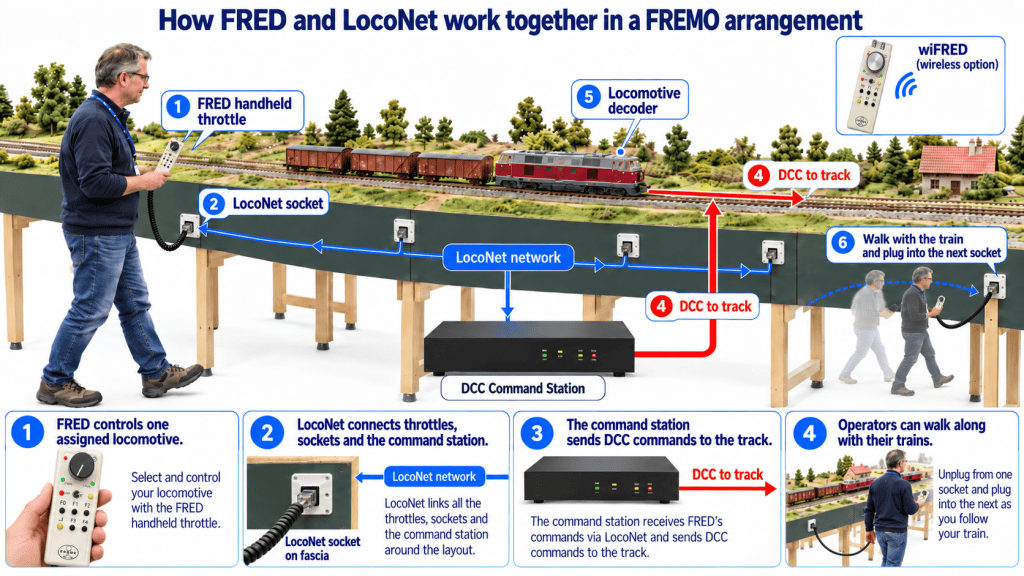
FRED, LocoNet and DCC: the roles of the handheld throttle, network and command station in FREMO operation.
Read more: FRED & LocoNet — Practical Guide explains locomotive assignment, wired and wireless control, LocoNet sockets and the role of the command station.
DEUTSCHE VERSION
Was mir am FREMO-Betrieb besonders gefällt, ist, dass ich meinen Zug begleiten kann, statt ihn von einem festen Bedienplatz aus zu steuern. Möglich machen das der FRED-Handregler und das LocoNet-Netzwerk.
FRED und LocoNet — so funktioniert es
Der FRED (FREMOs Einfacher Drehregler) ist ein einfach zu bedienender Handregler, dem eine Lokomotive zugewiesen wird. Damit lassen sich Geschwindigkeit, Fahrtrichtung und ausgewählte Funktionen steuern. Kabelgebundene FREDs werden über ein Spiralkabel mit Modularstecker an die LocoNet-Buchsen der Modulblenden angeschlossen.
LocoNet verbindet die Handregler und Buchsen mit der DCC-Zentrale. Diese überträgt die DCC-Befehle über die Gleise an den Lokdecoder.
Wenn mein Zug weiterfährt, kann ich den FRED an einer Buchse abziehen und an der nächsten wieder einstecken, ohne die Lokzuordnung zu verlieren. Mit einem wiFRED ist bei entsprechender Infrastruktur auch eine kabellose Steuerung möglich.
Für mich liegt der Vorteil auf der Hand: Ich kann meinen Zug begleiten, in Bahnhöfen anhalten und Rangierarbeiten gemeinsam mit anderen Teilnehmern durchführen.
FRED steuert die Lokomotive. LocoNet verbindet die Handregler mit der Zentrale. DCC überträgt die Befehle zur Lokomotive.
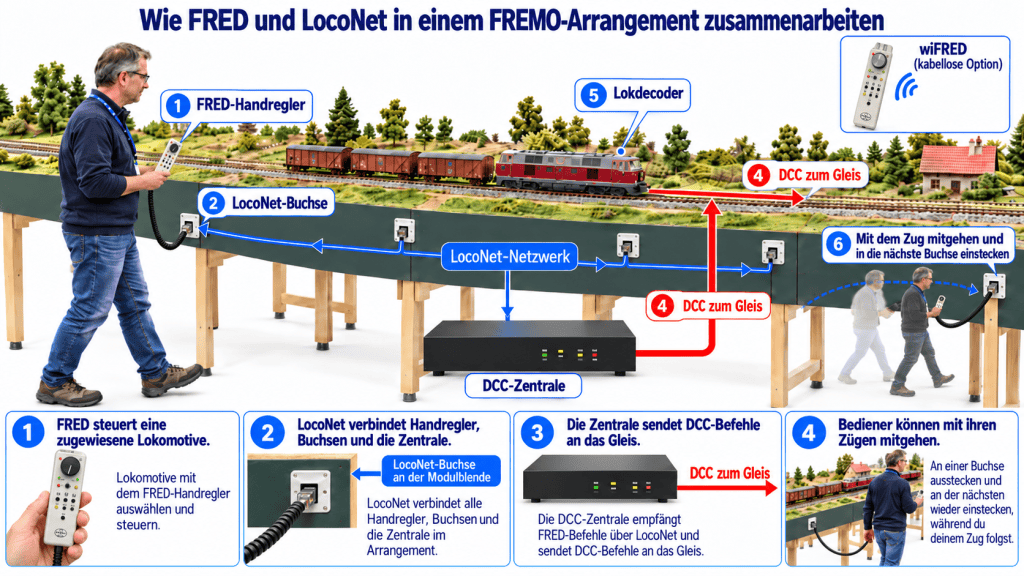
FRED, LocoNet und DCC: die Aufgaben des Handreglers, des Netzwerks und der Digitalzentrale im FREMO-Betrieb.
Ausführlicher Beitrag: FRED & LocoNet – ein praktischer Leitfaden erklärt Lokzuordnung, kabelgebundene und kabellose Steuerung, LocoNet-Buchsen und die Aufgabe der Digitalzentrale.

