

FREMO-Buchfahrpläne aus verschiedenen Epochen und Bahnunternehmen (von links nach rechts): Deutsche Bundesbahn aus Epoche III, Deutsche Reichsbahn aus Epoche IV und Deutsche Bahn aus Epoche V.
Working the Timetable
All duty plans are assigned a difficulty rating from Level 1 to Level 3, or equivalently from one to three stars.
Level 1 (★)
- Operate a passenger train, railcar, or simple freight train (Gag) from Point A to Point B.
- Make one or two intermediate stops according to the timetable.
- Follow signals and speed restrictions.
- On dispatcher-controlled secondary lines (Zugleitstrecken), request permission to proceed (Fahrerlaubnis, Fe) before departure and report your arrival (Ankunftmeldung, Ak) at the designated station.
- Usually involves little or no shunting.
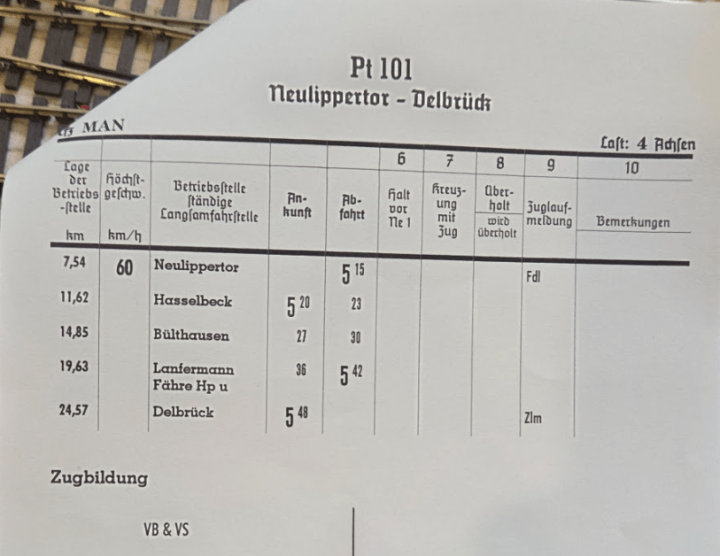
An example of a Level 1 duty: operating a three-unit railcar train from Neulippertor to Dellbrück. Upon arrival at Dellbrück, the conductor reports the train’s arrival (Ankunftmeldung, Ak) to the train dispatcher (Zugleiter).
Best suited for: Newcomers who want to become familiar with timetable operation, train reporting procedures, and the layout without the added complexity of shunting.
Level 2 (★★)
- Operate a local freight train (Ng), dropping off and picking up wagon groups along the route.
- Perform light shunting operations at intermediate stations and customer sidings.
- Work under the direction of a shunting manager (Rangierleiter), where required.
- Follow wagon cards and train documentation to ensure wagons are marshalled correctly.
- On dispatcher-controlled secondary lines (Zugleitstrecken), you may need to report your arrival (Ankunftmeldung, Ak) at intermediate stations and request permission to proceed (Fahrerlaubnis, Fe) for the next section of line.
Best suited for: Operators who are comfortable with timetable operation and train reporting procedures and are ready to learn basic freight handling and shunting.
Level 3 (★★★)
- Operate a local freight train (Ng) with extensive wagon pickup and set-out work along the route.
- Perform heavy shunting operations at intermediate stations and customer sidings.
- Work independently, without the assistance of a shunting manager (Rangierleiter).
- Plan and execute shunting moves efficiently while keeping to the timetable.
- Manage turnouts, derailers, keys, and local operating procedures on your own.
- Pause shunting activities and clear the main track when required for other trains.
- Set and restore routes as necessary to allow other trains to pass.
- Follow wagon cards and train documentation to ensure wagons are marshalled and delivered correctly.
- On dispatcher-controlled secondary lines (Zugleitstrecken), you may need to make arrival reports (Ankunftmeldung, Ak), request permission to proceed (Fahrerlaubnis, Fe), and provide departure or section-clear reports (Verlassenmeldung, Vm).
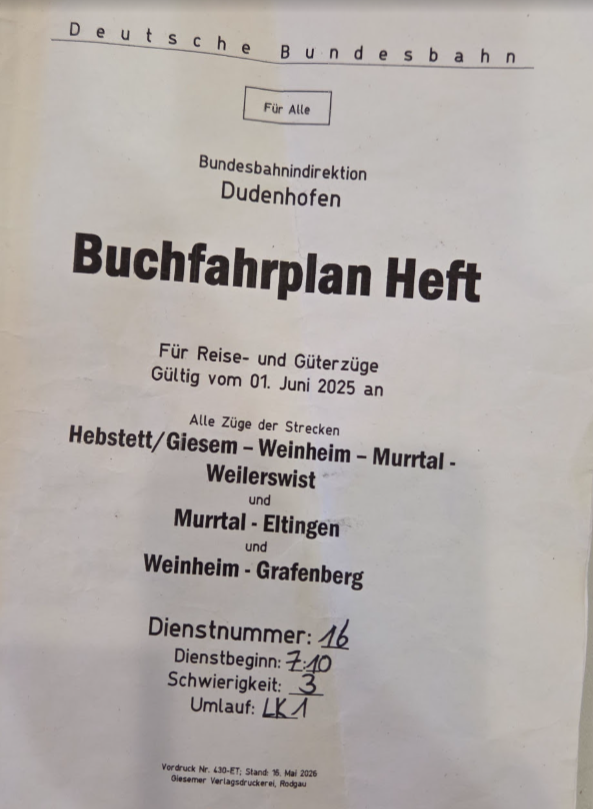
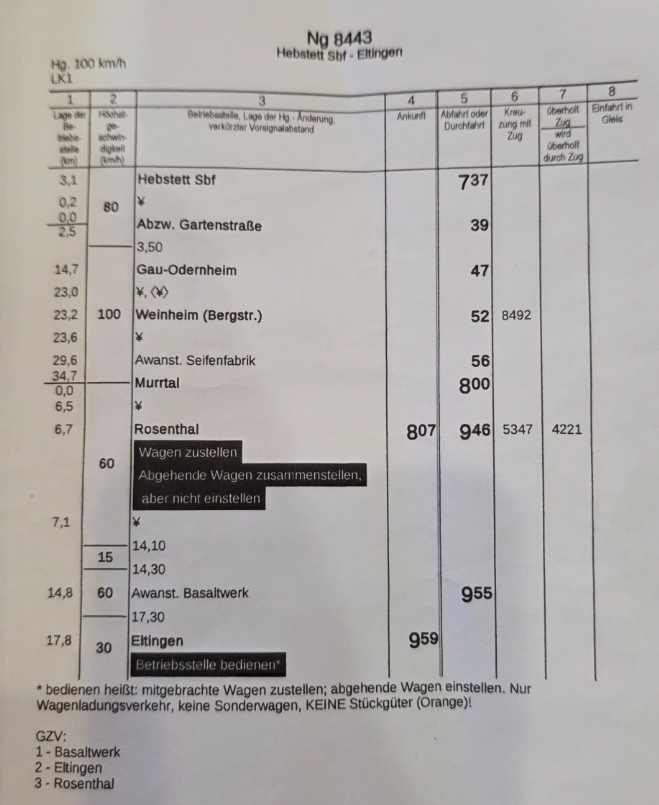
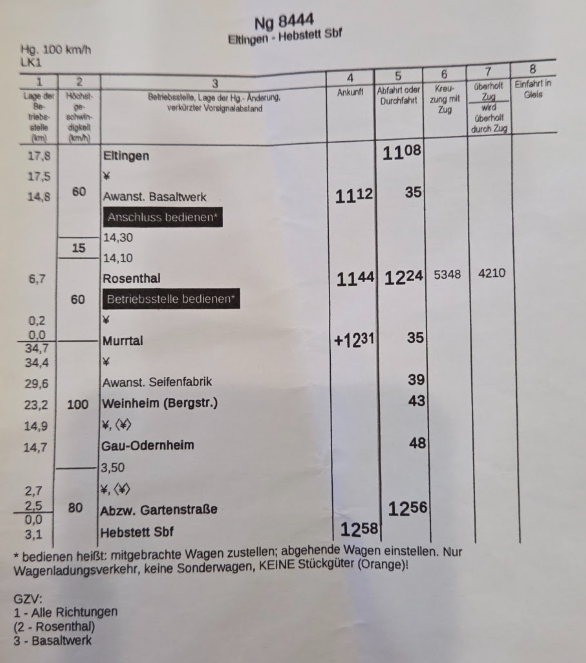
An example of a Level 3 duty plan consisting of two local freight train timetables Ng 8443 and Ng 8444. The drivier performs approximately two hours of shunting at Rosenthal and Eltingen on the outbound journey, followed by a further 45 minutes of shunting at Rosenthal on the return trip.
Best suited for: Experienced operators who are comfortable managing freight handling, independent decision-making, train reporting procedures, and complex shunting operations simultaneously.
Choosing a Duty Plan
Some duty plans contain only a single timetable with a fixed difficulty level. Others may include multiple timetables—sometimes a dozen or more—with a mix of difficulty levels throughout the session.
Choose a duty plan that matches your experience and comfort level. A well-chosen assignment will be far more enjoyable than one that leaves you struggling to keep up with the timetable or operating requirements.

