
Deutsche Version weiter unten, hier klicken.
Besides my posts covering module planning and construction progress, this page and its subpages document the final finished results for easier reference.
Concept Overview
If you have not read the history of the Verden–Walsroder Eisenbahn (VWE) and why I chose to model this private branch line, you can find it here. What drew me to building my first FREMO N-scale module was really the combination of three things: firstly, a compact industrial switching layout based on a real railway; secondly, the flexibility of a modular layout given my space constraints — not only at home, but also when transporting it in my car; and thirdly, becoming part of the FREMO N-RE community, where trains are operated using timetables and authentic German railway and VWE operating practices.
Verden (Aller) Süd is conceived as an Epoch IV (early–mid 1980s) VWE industrial switching module for FREMO N-RE operating sessions. The reason for choosing the 1980s is fairly straightforward: this was one of the peak periods in VWE freight traffic, driven by industrial development in the Eitze area and the growing concentration of the pet food manufacturing supply chain. For operations, that makes the location ideal. It gives me the chance to model a compact layout with intensive switching, varied freight movements, and a steady flow of local traffic without needing a large footprint.
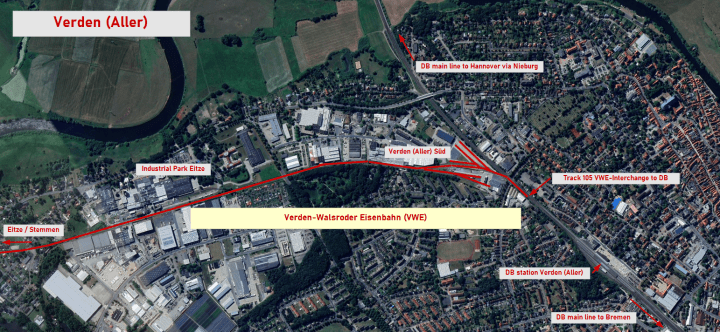
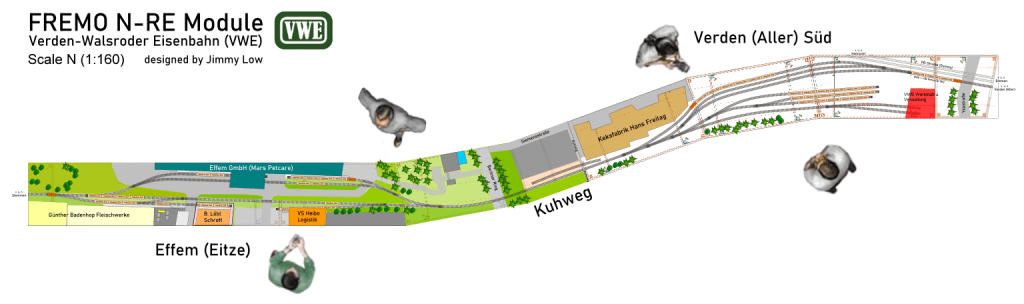
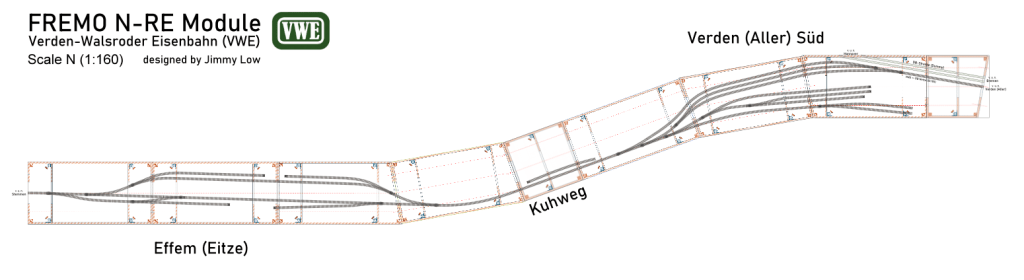
I am following a close prototype approach. The concept is grounded in the traffic patterns, customers, and operating practices of the 1980s, while selectively adopting a few later infrastructure changes where they improve operation within a modular FREMO environment.
Operational Intent in FREMO Context
Operations are based on the BD Hannover 1984/85 freight timetable (Buchfahrplan Güterzüge BD Hannover 1984/85). The operational focus is on local switching and transfer movements between Verden (Aller) Süd and Verden (off-scene fiddle yard), with realistic dwell times and shunting sequences.
What quickly became clear during planning is that the module needs to balance two roles at the same time: it has to work as a believable representation of the prototype, but it also needs to function reliably during FREMO sessions. In practice, that means handling a relatively high local freight density while still remaining transparent to through traffic from adjacent modules.
Those operational requirements are the main reason behind several of the compromises discussed later — and why I am willing to bend the “pure Epoch IV” approach in a few places where it improves operational flow.
DEUTSCHE VERSION
Konzeptübersicht
Falls du die Geschichte der Verden–Walsroder Eisenbahn (VWE) und die Gründe für meine Wahl dieser Privatbahn noch nicht kennst, findest du die Hintergründe hier.
Für mein erstes FREMO-N-Modul waren letztlich drei Faktoren ausschlaggebend: Zum einen ein kompaktes Industrieanschluss-Modul auf Basis eines realen Vorbilds, zum anderen die Flexibilität einer Modulanlage angesichts des begrenzten Platzes zu Hause und beim Transport im Auto. Der dritte und wichtigste Punkt war jedoch die Möglichkeit, Teil der FREMO-N-RE-Gemeinschaft zu werden, in der Züge nach Fahrplan und nach den Betriebsabläufen deutscher Privatbahnen – in diesem Fall der VWE – betrieben werden.
Verden (Aller) Süd ist als VWE-Industrieanschlussmodul der Epoche IV (frühe bis mittlere 1980er Jahre) für FREMO-N-RE-Betriebssessions konzipiert. Die Wahl dieses Zeitraums liegt auf der Hand: Die 1980er Jahre gehörten zu den verkehrsstärksten Phasen der VWE. Die industrielle Entwicklung im Bereich Eitze sowie die zunehmende Konzentration der Heimtierfutterindustrie sorgten für ein hohes Güteraufkommen. Für den Betrieb macht genau das den Standort besonders attraktiv. Auf vergleichsweise kleiner Fläche lassen sich intensive Rangieraufgaben, abwechslungsreiche Güterverkehre und ein kontinuierlicher Wagenfluss darstellen.
Bei der Umsetzung orientiere ich mich eng am Vorbild. Das Konzept basiert auf den Verkehrsströmen, Anschließern und Betriebsabläufen der 1980er Jahre. Gleichzeitig übernehme ich gezielt einige spätere infrastrukturelle Veränderungen, sofern sie den Betrieb im modularen FREMO-Umfeld sinnvoll unterstützen.
Betriebliche Zielsetzung im FREMO-Kontext
Grundlage des Betriebs ist der Güterzug-Buchfahrplan der Bundesbahndirektion Hannover 1984/85. Der Schwerpunkt liegt auf dem örtlichen Rangierdienst sowie den Übergabefahrten zwischen Verden (Aller) Süd und Verden (dem nicht dargestellten Fiddle Yard). Dabei sollen realistische Standzeiten, Rangierabläufe und Wagenbewegungen nachgebildet werden.
Bereits während der Planung wurde deutlich, dass das Modul zwei Anforderungen gleichzeitig erfüllen muss: Es soll einerseits ein glaubwürdiges Abbild des Vorbilds darstellen, andererseits aber auch im FREMO-Betrieb zuverlässig und praktikabel funktionieren. Das bedeutet in der Praxis, eine vergleichsweise hohe Dichte an örtlichem Güterverkehr abzuwickeln, ohne den Verkehr auf den angrenzenden Modulen unnötig zu beeinträchtigen.
Diese betrieblichen Anforderungen sind der Hauptgrund für einige der später beschriebenen Kompromisse. Deshalb bin ich an einzelnen Stellen bereit, vom strikt vorbildgerechten Epoche-IV-Zustand abzuweichen, wenn dadurch der Betriebsablauf im FREMO-Einsatz deutlich verbessert wird.
 FREMO:160 by traiNmaster