
14 years ago, when I started blogging my first post on model railroading and journaling my research on equipment, layout and materials for my now-defunct “Somewhere in Germany 1:160” segment layout, there was no ChatGPT or the likes. There were artificial intelligence (AI) though but not for commercial applications that we know of today.
So this time, I wanted to test out the capability of ChatGPT in conceptualising and optimising my new layout “Rheinstreck Rüdesheim”. We had productive “conversations” over 3 days during my commuting to and from work, and in the evening before bedtime.
Conversations with ChatGPT
Here are some snapshots of our “conversations” (note: our conversations were in German).
I was toying with the idea of a TT-scale (1:120) layout since it is between N-scale and H0-scale. I still have my N-scale and H0-scale rolling stock, tracks and turnouts. TT-scale is pretty common in former East Germany states but more vendors are now offering models in this scale, for example Hornby, Arnold, Piko and Roco, besides the traditional TT-scale manufacturer TILLIG.
I started by asking what is the minimum radius for a TT-scale layout and for a 2.0m x 0.6m layout. It recommended what are available from TILLIG and Piko.

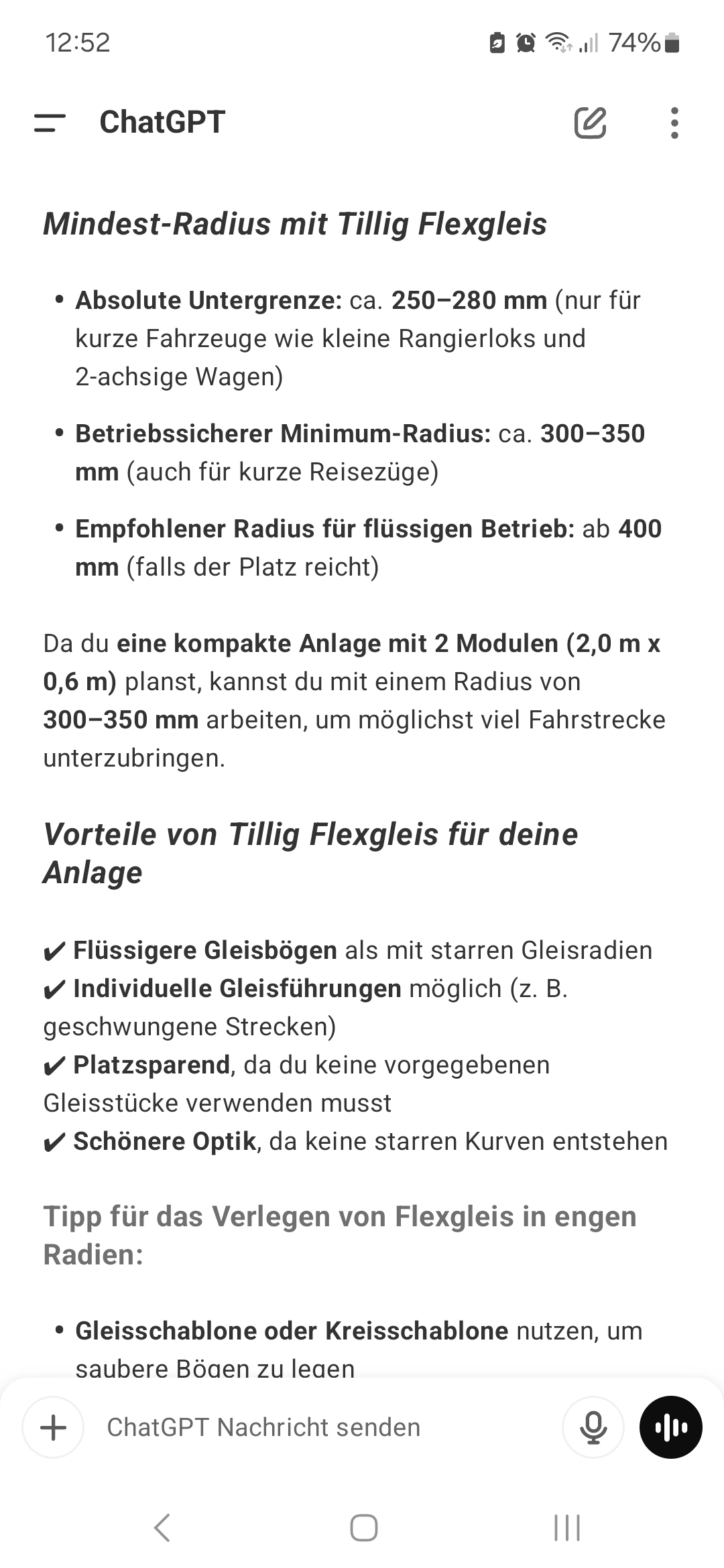
After many conversations, it proposed a track-plan for a 2.0m x 0.6m layout, of which 2/3rd will be visible. Up to this point, I am impressed with the track plan idea which closely matches what I want to model. We also discussed about landscape to add, track and height clearances to observe, what kind of rolling stock run on this right side of the Rhine (dt. Rhein) river and town Rüdesheim am Rhein and even wiring and how to operate in DC instead of DCC.

Half way through, I decided to switch “track”. I asked what do I need to change in the initial recommendations what I want to change to N-scale and with smaller space 1.0m x 0.7m.

I was always curious and fascinated with analog (DC) operation and how the wiring will work.

After 2 days conversation, I presented it a challenge. With a picture of an IKEA TV console and measurements 1.8m x 0.4m for visible area and extension 1.8m x 0.2m for staging area.

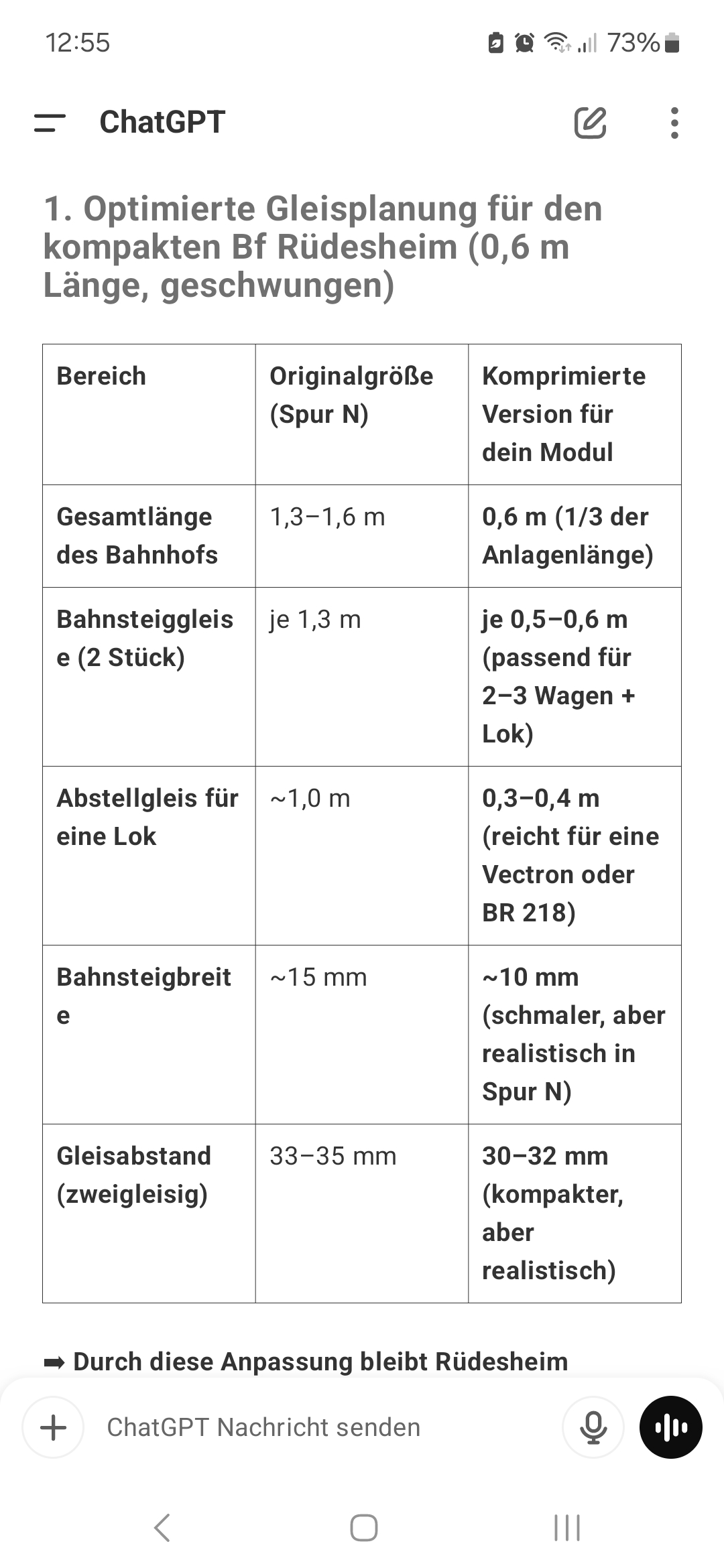
What I like about ChatGPT capability is it showed the original length in N-scale between 1.3m and 1.6m, and the compromised 1.0m length is still realistic.

I further reduced the station length to 0.6m. Here is a table of compact station with lightly-curved tracks. I wanted the station to occupy not more than 1/3rd of the layout.
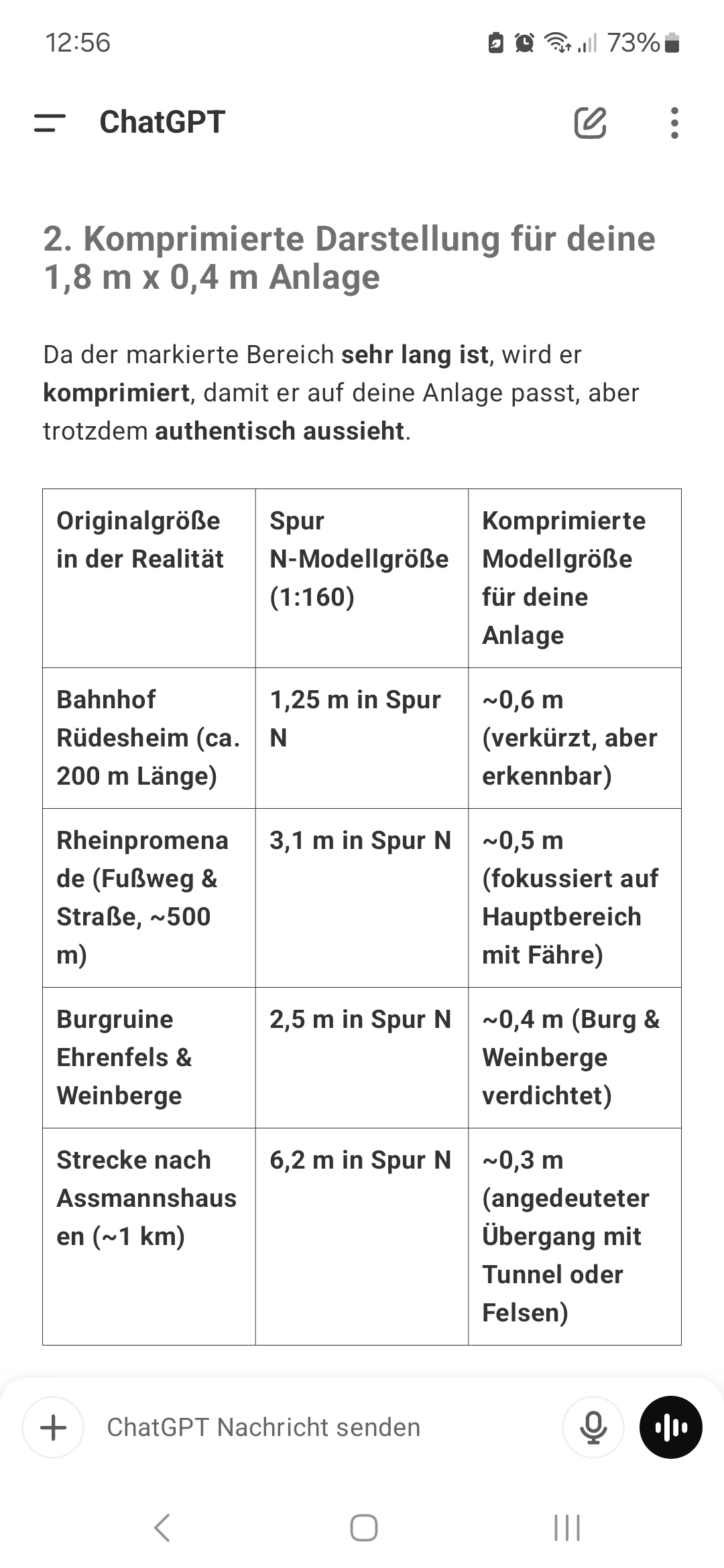
I fed it with a snapshot of the circled area that I wanted to model from Google Map. It took the key features such as Rüdesheim town, the station, Rhine promanade, Ehrenfels castle (ruined) and the wine yards and estimated the space that I could dedicate on the length of the layout (see the table below).

Last but not least, I asked ChatGPT to generate an image of how the layout will look like. What do you think?

Lessons Learned from 3-day Conversations with ChatGPT
- What would take me few months of reseach, took me a few hours of conversations.
- As I had experienced with track and layout planning, I could test and verify its capability in gathering and synthesizing the information from various sources especially in complying with NEM norms, track configurations and spacing within the parameters I set.
- As I have no experience with analog (DC) wiring, ChatGPT gave many recommendations – whether to use magnetic, relais or any other electronic components, as well as the available components and product names and numbers from various manufacturers. This gave me pointers to research further and fine-tune the cabling diagram.
- At the end of each long conversation, it summarised the key points that I could further use for my planning.
If you are considering ChatGPT or equivalent tool, it think it really enlighten your planning work especially in recommending various options, advantages and disadvantages of each options, complying with NEM/NMRA standards and norms, suitable equipment from various manufacturers.
There are more to explore with such AI tools. I am looking forward to using it extensively.
 germaN:160 by traiNmaster
Very interesting article. I don’t speak German, so will comment on the image.
I see a lot of errors with the image, buildings over tracks, curved mainline not connecting, and on the far right side, a train emerging from the river and crossing several switches as if these were automobiles.
How do you know the German text discussion does not have similar errors that will not be apparent until construction? Maybe the text has fewer errors than the image?
Thanks,
—
HOtrak
Image generated by ChatGPT is not perfect. I have one Image of a ship on the rail next to a railway station 😅😅
For the German text discussion, I am still reviewing and verifying against the NEM standards that I have blogged about 14 years ago so I can compare and correct them. As for others, I will always check.
The purpose of using ChatGPT is to allow it to generate the concept and key information via a series of questions and fine tuning along the way. I will take them and draw a proper layout and construction notes, just like as I did in the past. Even during construction, you will still make adjustments.