
Another challenge that I faced is how to construct my layout that can be easily stored and transported. Most people have a basement, room or even an attic to spare, even for a 4 by 8 foot layout. Yet, I will be constructing a 100cm by 226cm layout using IKEA IVAR frames (equivalent to 3,3 by 7,4 feet for those using the non-metric unit of measurements). I could not put my layout on a flat (normal) position due to lack of space in living room or even any other room. With the remodelling of my apartment living room, some spare space is available but when not using the layout, I need to be able to store it somewhere. Solution? A tilt-table layout! EUREKA!
I flipped through my “How to Build Model Railroad Benchwork” by Linn H. Westcott (published by Kalmbach Books) and found a short description and some photos of this tilt-table layout construction. Sadly, there were no measurements given.

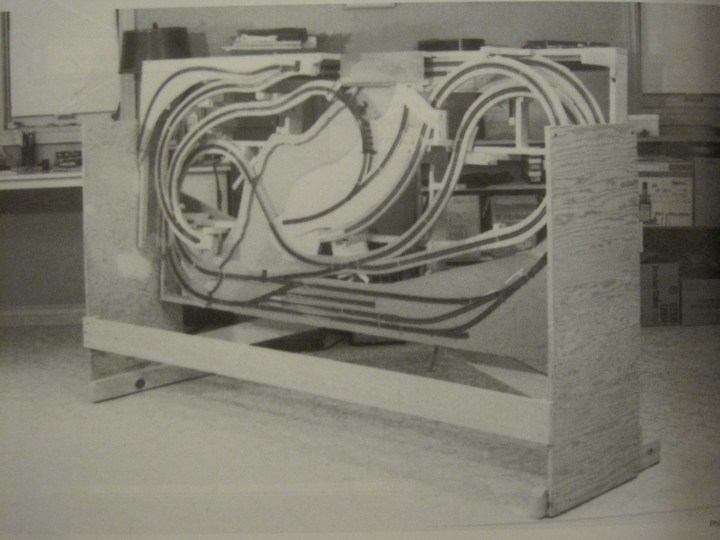

As you can see the middle picture shows the layout in storage position while the last picture shows it at working position. You don’t need to bend under to fix any wiring. You could flip to either direction by removing one of the pivots. At storage position, your table top and any structures that you build on top of it are protected by the width of the side brackets. Isn’t this a marvelous construction for those without space to store and work?
The above design got me working overtime and I produced these drawings. This construction can be dismantled and transported. This tilt-table layout results in 25% space reduction over a normal benchwork. Feel free to comment and download for your own use. The drawings are according to 1:10 scale. When you print, it may not be to scale but nonetheless you have measurements to guide you. Good luck and let me know how you fare.


 germaN:160 by traiNmaster
I was referred by Nscale.org members to this page, where the modeller built a tilt-table layout
http://www.nscale.org/forum/frameset.html?http://www.nscale.org/forum/showthread.php?t=25847
Great to know there is another modeller with a tilt-table layout
http://www.nscale.net/forums/album.php?albumid=131&page=3
Looks like this construction can offer you some advantages.
I have been looking high and low for a tilt a table as well and this too is a very good one. Although, I reside in Canada, rest assured I need to make space too.
Hello E Faber,
I look forward to seeing your tilt table layout. I am working out the cost to build one.
The Wescott photos look like US construction. Based on that, I am guessing the following dimensions based on proportions of the pieces:
Vertical Supports: 2×4 feet or 610 x 1219 mm, probably 0.75 inch thick, or 19 mm. the 48-inch height is a better viewing height for an N-scale layout.
Vertical Support Feet: Look to be made of a US 2×4, actually 1.5 x 3.5 inches or 38 x 90 mm.
Front Horizonal Cross Brace: Appears to be a US 1×6 or 0.75 x 5.5 inches actual or 19 x 140 mm.
Rear Diagonal Braces: Look like a pair of US 1×4 or 0.75 x 3.5 inches actual or 19 x 90 mm.
Train Table Size: This looks like an N-scale layout. The frame grid is 3×6. If it is 12 inch spacing, the layout is 3 x 6 ft US or 914 x 1928 mm. If the spacing is 16 inches, a common US practice, the table size is 4×8 feet or 1219 x 2438 mm, the standard size of US plywood sheets. The plywood is probably ½ inch thick, or 12.7 mm because that is recommended practice in the US.
Frame Gridwork: It is hard to tell from the photos, but the framing might be from US 2x4s. This is based on comparing the thickness of the frame grid with the thickness of the diagonal supports holding the layout up. The two endpieces appear to be a little higher than the actual grid, and might be US 2x6s. This would add strength to better carry the weight of the frame grid and help protect the ends of the scenery.
I was planning for an N-scale tiltable layout. As I do not have the exact Wescott measurements, I made a best guess. Thanks for your measurements and tips.