
Note: Note: This will be a series of posts relating to my first FREMO N-scale module based on N-RE (Spur N Regelspur Europa; N-scale Standard Gauge Europe) standards. I hope you will enjoy reading about the background of a private branch line (private Nebenbahn) located near the river Aller in Lower Saxony (Niedersachsen), as well as my planning, construction, and eventually the operation of the FREMO module.
Deutsche Version weiter unten, hier klicken.
Living the Philosophy: DB Sets the Clock, Effem Determines the Priority, VWE Keeps the Flow
In my freight operations concept post, I described the transfer between the DB Verden interchange (off-scene fiddle yard or FREMO interchange) and Verden Süd, and how the industries are switched through the week. The timetable is clear and the instructions are clear.
But reading it back a few times, I realised something important. Once this becomes a real layout, I won’t be asking what should I do? anymore. I’ll be asking how many wagons must exist so this never stalls, where those wagons physically are before the session starts, and what Monday morning must look like so the work is obvious before I even touch the throttle.
This is no longer about track plans. It is about setting the chessboard so the first move already makes sense.
How Many Wagons (aka “Chess-Pieces”) Do I Need?
The first thing that determines what Monday looks like is simply this: how many wagons must exist in the system so nothing ever blocks.
To support this flow reliably, I worked out that I need 29–30 wagons. That sounds like a lot for a small industrial switching layout, until you remember I am modelling the traffic of a key VWE customer in the 1980s, not a quiet branch line.
| Wagon type | Recommended count | Why |
|---|---|---|
| Ucs/Uaoos (114 mm) | 12 | Bulk at Effem + inbound/outbound cycles |
| Gbs (176 mm) | 13 | Core covered traffic, Effem/Freitag |
| Tms (176 mm) | 2 | Occasional heavy goods (rare but useful) |
| Eanos (196 mm) | 2 | Löbl scrap traffic |
Optional: 1 stake wagon for rare/odd loads
This number is not random. It fits both the layout logic and the capacity of the three-track DB interchange fiddle yard.
But knowing the number of wagons is not enough. I now have to decide where those wagons actually live on Sunday night—and most of them are not on the layout.
Enter the Off-Scene Fiddle Yard “DB Verden Interchange”
The fiddle yard is not storage. It represents the DB world.
At FREMO, this is where the day is quietly controlled. At home, I need a miniature version of that world: a three-track fiddle yard where each track has a strict operational role.
- Track A holds the inbound empties for Üg 66455 and starts the session with three empty Ucs and two empty Gbs wagons, occupying about 694 mm.
- Track B s the outbound pickup track and starts empty.
- Track C represents the DB reserve and holds one Eanos and one Gbs as background wagons.
| Fiddle track | Purpose | Start status |
|---|---|---|
| Track A (800mm) | Inbound empties (Üg 66455) | 3× Ucs + 2× Gbs empties (694 mm) |
| Track B (800mm) | Outbound pickup | Empty at start |
| Track C (800mm) | DB reserve / variation | 1× Eanos + 1× Gbs (background wagons) |
These three tracks now have defined roles:
- Track A: delivery of empties (DB outbound / VWE inbound)
- Track B: where outbound cut disappears later (VWE outbound / DB inbound to the world (off-scene))
- Track C: off-scene DB world for variation and later appearances (reserved for any pool wagons)
One hard rule keeps this believable: Track A must never hold more than five wagons in a mixed consist.
The fiddle yard now defines what arrives on Monday. The layout must be arranged so that this arrival immediately creates work.
Setting Up the On-Scene for the Monday Start-of-Session
Monday morning must be readable at a glance. You should be able to look at the layout and immediately think, “Right. This is why I’m busy.”
Effem First
Because Effem determines priority, these sidings must look like they were genuinely worked on Saturday, not staged for display.
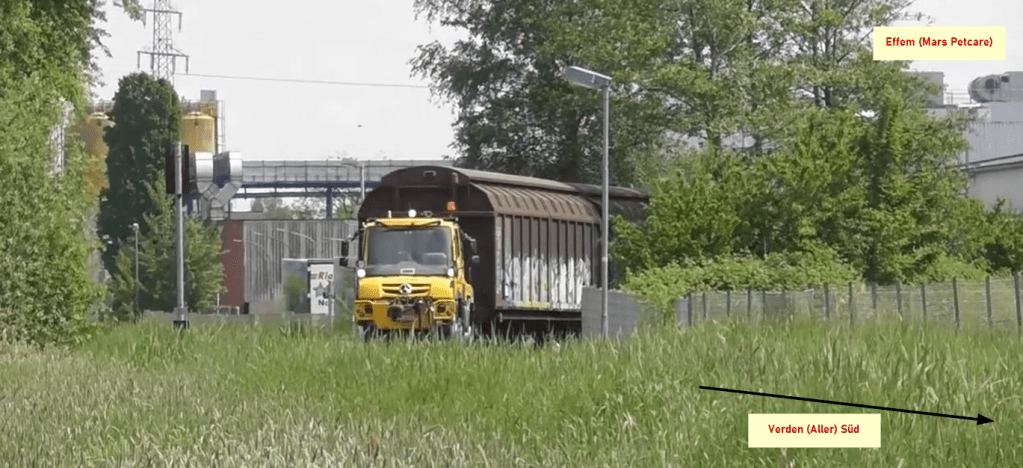
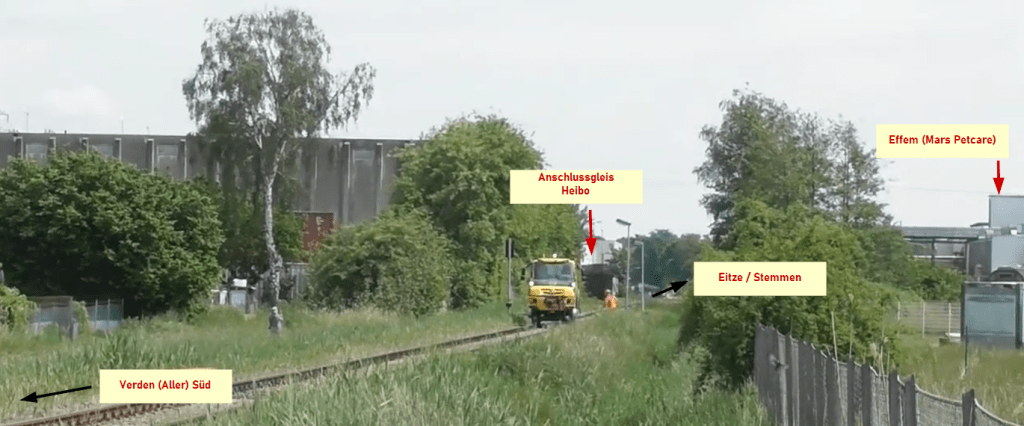
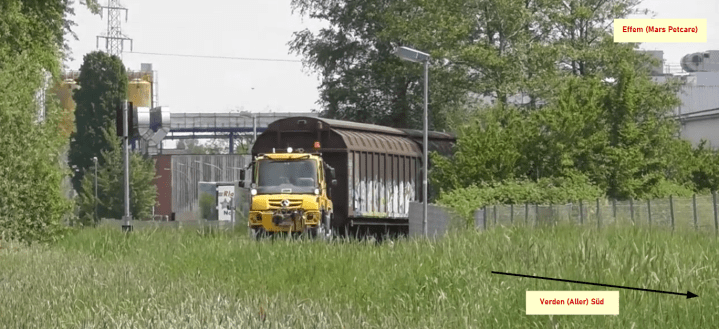
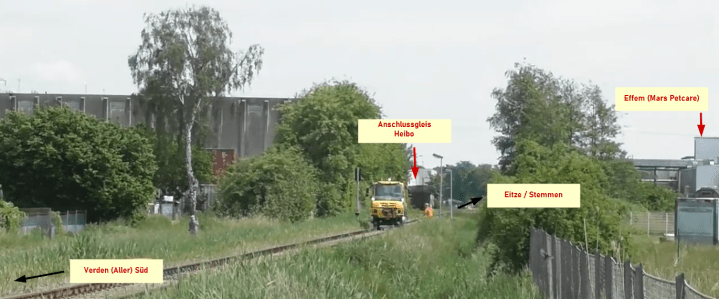
VWE’s Zagros Unimog rail-road tractor switching wagons at Mars Petcare siding (above and below). Photo: Uwe Hilgemann / YouTube.
At E1 at Effem, which holds five Ucs, there should be three loaded and two empty wagons. At E2, which takes three Gbs or Tms, there should be two loaded and one empty. At Hans Freitag, the inbound track ideally holds one empty wagon, and the outbound track holds one loaded wagon.
| Siding | Capacity | Typical start state |
|---|---|---|
| E1 (Effem) | 5× Ucs | 3 loaded + 2 empty |
| E2 (Effem) | 3× Gbs/Tms | 2 loaded + 1 empty |
| F1 (Freitag inbound) | ~10 | Ideally 1 empty (optional) |
| F2 (Freitag outbound) | ~10 | 1 loaded (optional) |
This is what forces the rest of Verden Süd to be arranged the way it is. Effem will always get first call on empties from Track 3.
Verden Süd
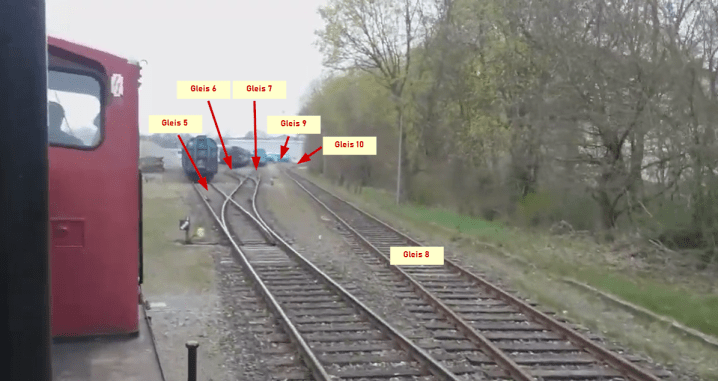
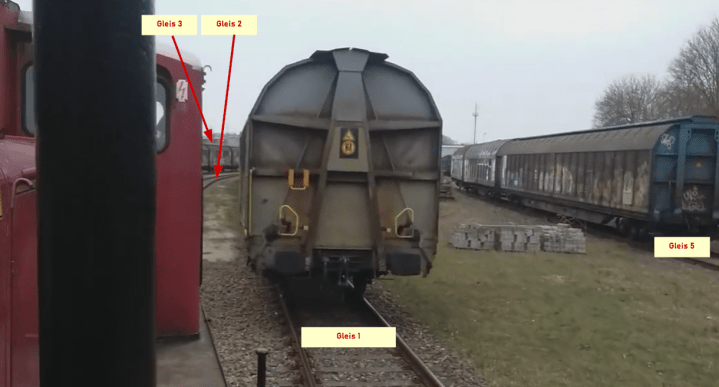
Track 1 is already telling the story because it is prepared for the 07:46 Üg 66452 pickup with five loaded wagons. Track 2, the run-around, must always be empty. Track 3, the inbound and distribution track at 1386 mm, is empty on Monday morning but would otherwise be filled from the previous day. Track 4 may optionally hold one Eanos for Löbl. Track 5 remains empty unless there are leftovers from previous work.
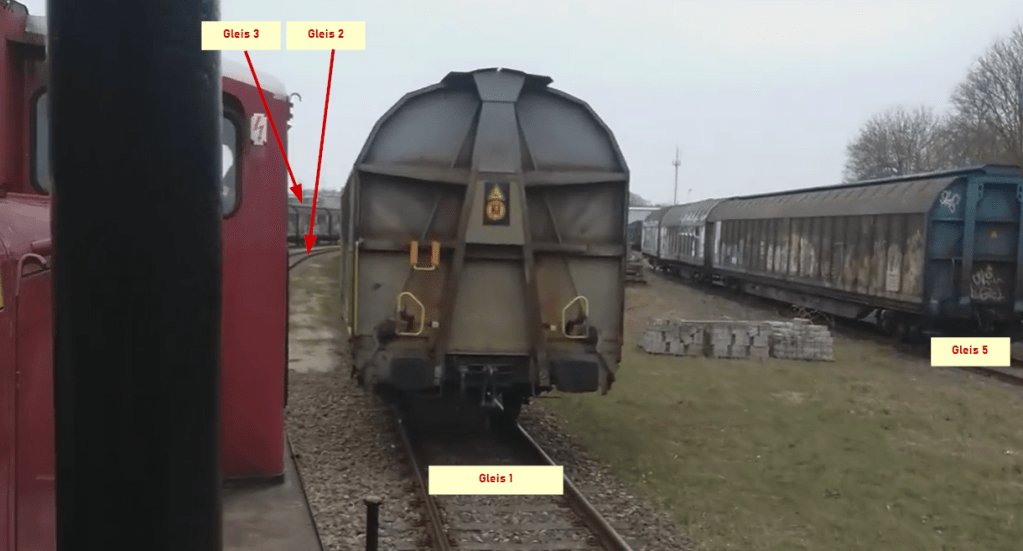
Passing by VWE’s Verden (Aller) Süd sidings. Photo: Tüte R. / YouTube.
The track numbers on my module differs from the actual due to modelling selective compression. Not all features are represented in my module.
| Track | Role | Typical start fill |
|---|---|---|
| Track 1 (1230 mm) | Outbound DB pickup | 5 loaded wagons |
| Track 2 (1064 mm) | Run-around | Always empty |
| Track 3 (1386 mm) | Inbound/distribution | Empty on Monday start; otherwise, filled from yesterday |
| Track 4 (774 mm) | Löbl / open | 1× Eanos (optional) |
| Track 5 (780 mm) | Seasonal / buffer | Empty unless leftovers present |
What Happens in a Typical Monday Session
This is where the Monday setup proves itself. The yard work does not happen because I feel like switching. It happens because Üg 66455 arrives, Track 3 fills up, and Üg 66452 is already looming.
| Time Window (VS) | RF | Related DB Slot | Trigger / Dependency | Main Tasks | Must Be Completed By |
|---|---|---|---|---|---|
| 06:00–06:30 | — | Slot A (prep) | Before Üg 66455 arrival | Prepare Verden Süd: clear Track 2, prepare Track 3, position shunting loco | 06:30 |
| ~06:30 | — | Slot A | Üg 66455 arrival | Standby to cut and transfer inbound wagons | — |
| 06:40–06:55 | — | Slot A | After Üg 66455 arrival (~06:30) | Transfer inbound wagons Verden → Verden Süd | 06:55 |
| 06:55–08:10 | RF-A | Slot A | Inbound wagons on Track 3 | Distribute empties to Effem, Freitag, seasonal tracks | — |
| 06:55–07:25 | RF-B | Slot B | Before Üg 66452 departure (~07:45) | Assemble early outbound cut on Track 1 (Effem priority) | 07:30 (wagons must leave Verden Süd) |
| 07:30–07:45 | — | Slot B | Before DB departure | Transfer outbound cut Verden Süd → Verden, couple & brake test | 07:45 |
| ~07:45 | — | Slot B | Üg 66452 departure | Shunting loco returns to Verden Süd | — |
Before 06:30, Track 2 is cleared, Track 3 is prepared, and the shunting locomotive is positioned. At around 06:30, Üg 66455 arrives and the inbound wagons are cut and received. Between 06:40 and 06:55, those wagons are transferred from Verden to Verden Süd and placed on Track 3. From 06:55 onwards, empties are distributed primarily to Effem while the early outbound cut is assembled on Track 1 in time for the 07:30 transfer back to Verden for the 07:45 departure of Üg 66452.
In modeller language, DB empties wait off-scene on Track A to be delivered to Track 3. The yard switcher takes the ready outbound wagons from Track 1 and moves them to DB via Track B. The Effem Köf immediately starts grabbing Ucs/Uaoos empties and Gbs/Tms loads, using the Badenhop/Heibo spur as temporary breathing space if necessary, and feeds suitable wagons back to Track 1 for the next outbound. Only when Effem is satisfied does the yard operator deal with Hans Freitag or Track 4 and 5. DB then “returns” and removes Track 1 to the off-scene world.
Where Are We at 07:45?
If this has been done properly, the layout now looks operationally correct. DB inbound wagons stand on Track 3 waiting for Effem. Hans Freitag wagons are cut aside, waiting their turn. The outbound cut has disappeared to Track B and is mentally on its way to Bremen.
You do not need to remember what happened. The tracks tell you.
The Weekly Cycle in One Glance
The reason this Monday works is because the week always leaves the yard in a predictable state.
On Monday, Track 1 is full and Track 3 is empty, and the first job is always the Effem workflow. From Tuesday to Friday, Track 3 is occupied and Track 1 is empty, so the work consists of sorting the previous day’s traffic. On Saturday, the yard is finally sorted and prepared for Monday by building the next outbound and clearing Track 3.
| Day | Yard condition at start | First job |
|---|---|---|
| Monday | Track 1 full, Track 3 empty | Effem workflow |
| Tuesday–Friday | Track 3 occupied, Track 1 empty | Sort yesterday’s traffic |
| Saturday | Final sorting, prep Monday | Build next outbound, clear Track 3 |
Saturday Reset: Setting Up Next Monday
On Saturday, the goal is not more shunting but preparing a clean Monday story. All tracks in Verden Süd are cleared. The last outbound is moved into fiddle Track B. Suitable wagons are converted into the next Track A empties. Effem is deliberately left half-done and Track 3 deliberately left empty.
By the time Saturday ends, I am not tidying up.
I am setting the chessboard for Monday morning!
DEUSTCHE VERSION
Hinweis: Dies ist der Auftakt zu einer Reihe über mein erstes FREMO-Modul in Spur N nach N-RE-Norm. Es geht mir hier nicht darum, die Geschichte vollständig nachzuerzählen, sondern zu zeigen, was ich recherchiert habe – und wie genau das meine Planung, meinen Bau und später meinen Betrieb beeinflusst.
Verden-Walsroder Eisenbahn (VWE): Setup für die Montagszustellung
Die gelebte Philosophie: DB setzt die Uhr, Effem bestimmt die Priorität, VWE hält den Fluss am Laufen
In meinem Beitrag zum Fracht-Betriebskonzept habe ich den Übergang zwischen dem DB-Anschluss Verden (off-scene Fiddle Yard bzw. FREMO-Übergabebahnhof) und Verden Süd beschrieben, ebenso das Rangieren bei den einzelnen Anschließern im Wochenverlauf. Der Fahrplan ist klar, die Abläufe sind klar, die Regeln sind definiert.
Beim erneuten Lesen ist mir aber etwas Entscheidendes aufgefallen. Sobald das Ganze als reale Anlage existiert, werde ich nicht mehr fragen: Was soll ich jetzt tun?
Stattdessen werde ich mich fragen: Wie viele Wagen müssen überhaupt im System sein, damit nichts ins Stocken gerät? Wo befinden sich diese Wagen physisch, bevor die Session beginnt? Und vor allem: Wie muss ein Montagmorgen aussehen, damit die Arbeit sofort offensichtlich ist – noch bevor ich den ersten Regler anfasse?
Es geht hier nicht mehr um Gleispläne. Es geht darum, das Schachbrett so aufzubauen, dass der erste Zug logisch ist.
Wie viele Wagen (aka „Schachfiguren“) brauche ich?
Die erste Frage, die darüber entscheidet, wie sich der Montag anfühlt, ist ganz banal: Wie viele Wagen müssen im System vorhanden sein, damit nichts blockiert?
Um diesen Ablauf zuverlässig darstellen zu können, habe ich ermittelt, dass ich 29–30 Wagen benötige. Das klingt viel für eine kleine Industrie-Rangieranlage – bis man sich klar macht, dass hier der Verkehr eines zentralen VWE-Kunden der 1980er Jahre simuliert wird und nicht eine verschlafene Nebenbahn mit zwei Wagen und einem Pwgs.
VWE-Zagros-Unimog als Zweiwegefahrzeug beim Rangieren von Güterwagen am Mars-Petcare-Anschluss (oben und unten). Foto: Uwe Hilgemann / YouTube.
Diese Zahl ist kein Zufall. Sie passt sowohl zur betrieblichen Logik der Anlage als auch zur Kapazität des dreigleisigen DB-Übergabe-Fiddle-Yards.
Aber die reine Anzahl reicht nicht aus. Als Nächstes muss klar sein, wo sich diese Wagen am Sonntagabend befinden – und die meisten davon stehen nicht auf der sichtbaren Anlage.
Das Off-Scene-Fiddle-Yard „DB Verden Übergabe“
Das Fiddle Yard ist kein Abstellgleis. Es ist die DB-Welt.
Bei FREMO wird von hier aus der ganze Betriebstag gesteuert. Zu Hause brauche ich eine stark verkleinerte, aber logisch identische Version davon: ein dreigleisiges Fiddle Yard, in dem jedes Gleis eine klar definierte Aufgabe hat.
- Gleis A ist 800 mm lang und nimmt die leeren Wagen der Üg 66455 auf. Zu Sitzungsbeginn stehen hier drei leere Ucs und zwei leere Gbs, zusammen etwa 694 mm.
- Gleis B ist ebenfalls 800 mm lang und dient als Abholgleis für ausgehende Wagen – es ist zu Beginn leer.
- Gleis C repräsentiert die DB-Reserve bzw. „die große weite Welt“ und ist mit einem Eanos und einem Gbs als Hintergrundbestand belegt.
Hintergrundbestand belegt.
| Fiddle-Gleis | Zweck | Startzustand |
|---|---|---|
| Gleis A (800 mm) | Eingehende Leerwagen (Üg 66455) | 3× Ucs + 2× Gbs leer |
| Gleis B (800 mm) | Ausgehende Übergabe | leer |
| Gleis C (800 mm) | DB-Reserve / Variation | 1× Eanos + 1× Gbs |
Die Rollen sind eindeutig:
- Gleis A liefert Leerwagen von DB an die VWE.
- Gleis B nimmt fertige Übergaben von der VWE zurück zur DB auf.
- Gleis C sorgt für Variation und spätere Wiederauftritte einzelner Wagen.
Eine harte Regel hält das Ganze glaubwürdig: Auf Gleis A dürfen in gemischter Zusammenstellung nie mehr als fünf Wagen stehen. So bleibt es eine Übergabe – und kein versteckter Schattenbahnhof.
Damit ist festgelegt, was am Montag ankommt. Jetzt muss die sichtbare Anlage so vorbereitet sein, dass diese Ankunft automatisch Arbeit erzeugt.
Aufbau der Anlage für den Montag-Start
Der Montagmorgen muss auf einen Blick verständlich sein. Ein Blick auf die Gleise soll reichen, um zu denken: „Alles klar – deshalb bin ich jetzt beschäftigt.“
Zuerst Effem (und Hans Freitag)
Da Effem die Prioritäten bestimmt, müssen diese Anschlüsse so aussehen, als wären sie am Samstag tatsächlich bearbeitet worden – nicht wie frisch dekoriert.
Im Gleis E1 bei Effem, das fünf Ucs fasst, stehen drei beladene und zwei leere Wagen. Im Gleis E2 mit Platz für drei Gbs oder Tms stehen zwei beladene und ein leerer Wagen. Bei Hans Freitag steht idealerweise ein leerer Wagen im Eingangs- und ein beladener Wagen im Ausgangsgleis.
| Anschluss | Kapazität | Typischer Startzustand |
|---|---|---|
| E1 (Effem) | 5× Ucs | 3 beladen + 2 leer |
| E2 (Effem) | 3× Gbs/Tms | 2 beladen + 1 leer |
| F1 (Freitag Eingang) | ~10 | ideal 1 leer |
| F2 (Freitag Ausgang) | ~10 | 1 beladen |
Genau dieser Zustand zwingt den restlichen Bahnhof in seine Startkonfiguration. Effem hat immer das Erstzugriffsrecht auf Leerwagen aus Gleis 3.
Verden Süd
Gleis 1 erzählt die Geschichte sofort: Es ist mit fünf beladenen Wagen für die 07:46 Üg 66452 vorbereitet. Gleis 2 dient ausschließlich als Umfahrgleis und ist leer. Gleis 3 (Ein- und Verteilgleis) ist am Montagmorgen bewusst leer, an anderen Tagen aber vom Vortag belegt. Gleis 4 kann optional einen Eanos für Löbl enthalten. Gleis 5 bleibt leer, solange keine Restwagen vorhanden sind.
Vorbeifahrt an den Anschlussgleisen der VWE in Verden (Aller) Süd. Foto: Tüte R. / YouTube.
Die Gleisnummern auf meinem Modul weichen aufgrund der modellbahnerischen Kompression vom Vorbild ab; nicht alle Einrichtungen sind im Modell dargestellt.
| Gleis | Funktion | Typischer Startzustand |
|---|---|---|
| Gleis 1 (1230 mm) | DB-Abholung | 5 beladene Wagen |
| Gleis 2 (1064 mm) | Umfahrgleis | immer leer |
| Gleis 3 (1386 mm) | Eingang / Verteilung | Montag leer |
| Gleis 4 (774 mm) | Löbl / offen | 1× Eanos (optional) |
| Gleis 5 (780 mm) | Saison / Puffer | leer |
Was passiert an einem typischen Montag?
Hier zeigt sich, ob der Aufbau funktioniert. Es wird nicht rangiert, weil man Lust darauf hat, sondern weil Üg 66455 ankommt, Gleis 3 sich füllt und Üg 66452 bereits im Nacken sitzt.
| Zeitfenster | DB-Slot | Auslöser | Aufgabe | Muss fertig sein |
|---|---|---|---|---|
| 06:00–06:30 | Slot A | vor Üg 66455 | Gleis 2 freimachen, Gleis 3 vorbereiten, Lok bereitstellen | — |
| ~06:30 | Slot A | Üg 66455 | Wagen übernehmen | — |
| 06:40–06:55 | Slot A | nach Ankunft | Übergabe Verden → Verden Süd | 06:55 |
| 06:55–07:25 | Slot B | vor Üg 66452 | Frühzeitige Ausgangsgruppe auf Gleis 1 bilden (Effem zuerst) | 07:30 |
| 07:30–07:45 | Slot B | vor Abfahrt | Übergabe nach Verden, Kuppeln, Bremsprobe | 07:45 |
Vor 06:30 ist Gleis 2 frei, Gleis 3 vorbereitet und die Rangierlok positioniert. Gegen 06:30 trifft die Üg 66455 ein. Zwischen 06:40 und 06:55 werden die Wagen nach Verden Süd übernommen und auf Gleis 3 bereitgestellt. Ab 06:55 wandern die Leerwagen vorrangig zu Effem, während gleichzeitig die frühe Ausgangsgruppe auf Gleis 1 entsteht, rechtzeitig für die Rückgabe nach Verden und die Abfahrt der Üg 66452 um 07:45.
In Modellbahner-Sprache: Die DB-Leerwagen warten off-scene auf Gleis A und kommen auf Gleis 3. Der Bahnhofsrangierer bringt die fertigen Wagen von Gleis 1 nach DB (Gleis B). Die Effem-Köf greift sofort nach Ucs-Leerwagen und Gbs/Tms-Ladewagen, nutzt bei Bedarf Badenhop/Heibo als Atemgleis und füttert Gleis 1 für die nächste Übergabe. Erst wenn Effem zufrieden ist, kommen Hans Freitag oder Gleis 4/5 an die Reihe. Danach „kehrt“ DB zurück und zieht Gleis 1 ab.
Wo stehen wir um 07:45?
Wenn alles sauber gelaufen ist, liest sich der Bahnhof selbst. Die DB-Eingangswagen stehen auf Gleis 3 und warten auf Effem. Die Wagen für Hans Freitag sind abgesetzt und warten. Die Ausgangsgruppe ist verschwunden – gedanklich bereits auf dem Weg nach Bremen.
Man muss sich nichts merken. Die Gleise erzählen die Geschichte.
Der Wochenzyklus auf einen Blick
Dieser Montag funktioniert nur, weil die Woche den Bahnhof immer in einen definierten Zustand zurückführt.
Am Montag ist Gleis 1 voll und Gleis 3 leer – Effem beginnt. Dienstag bis Freitag ist Gleis 3 belegt und Gleis 1 leer – es wird sortiert, was gestern liegen blieb. Am Samstag wird aufgeräumt und für den nächsten Montag vorbereitet.
| Tag | Zustand zu Beginn | Erste Aufgabe |
|---|---|---|
| Montag | Gleis 1 voll, Gleis 3 leer | Effem-Workflow |
| Di–Fr | Gleis 3 belegt, Gleis 1 leer | Vortag sortieren |
| Samstag | Endsortierung | Nächsten Montag vorbereiten |
Samstags-Reset: Vorbereitung für den nächsten Montag
Am Samstag geht es nicht darum, möglichst viel zu rangieren. Es geht darum, eine saubere Montag-Geschichte zu hinterlassen.
Alle Gleise in Verden Süd werden geräumt. Die letzte Ausgangsgruppe wandert nach Gleis B. Passende Wagen werden zu neuen Gleis-A-Leerwagen „umgewandelt“. Effem bleibt bewusst halbfertig, Gleis 3 bewusst leer.
Wenn der Samstag endet, räume ich nicht auf.
Ich stelle das Schachbrett für den Montagmorgen auf.
 germaN:160 by traiNmaster