
Note: This will be a series of posts relating to my first FREMO N-scale module based on N-RE (Spur N Regelspur Europa; N-scale Standard Gauge Europe) standards. I hope you will enjoy reading about the background of a private branch line (private Nebenbahn) located near the river Aller in Lower Saxony (Niedersachsen), as well as my planning, construction, and eventually the operation of the FREMO module.
Deutsche Version weiter unten, hier klicken.
A Quick Recap
What I didn’t quite realise when starting this project is that the prototype at Verden Süd naturally lends itself to two operating modes: a single operator doing everything, or multiple operators each representing a different “railway” working in the same yard.
I think you can clearly see my inclination toward—and excitement about—building a freight-operations-centric module. This approach fits perfectly with FREMO meetings, which place a strong emphasis on freight traffic, typically in Epoch III or IV, while still being adaptable to more modern epochs such as Epoch V or VI. With additional module extensions, the module can also be used as a home layout.
For background, see my previous posts on the history of the Verden–Walsroder Eisenbahn (VWE) and the initial track plan concept. This post picks up from there and focuses on what I learned once I started translating prototype facts into an actual operating day. The track plan will continue to evolve as I receive feedback from other modellers and adapt to changing requirements.
To explain why that matters for the model, I first need to show what actually dominated freight traffic at Verden Süd in the 1980s.

What Was Actually Happening at Verden Süd in the 1980s?
VWE Freight Volume in 1980s
In my first post on the history of the Verden–Walsrode Railway, I described how freight switching for industries along both the Verden and Walsrode lines provided a vital lifeline for the continued existence of this small private branch line railway.
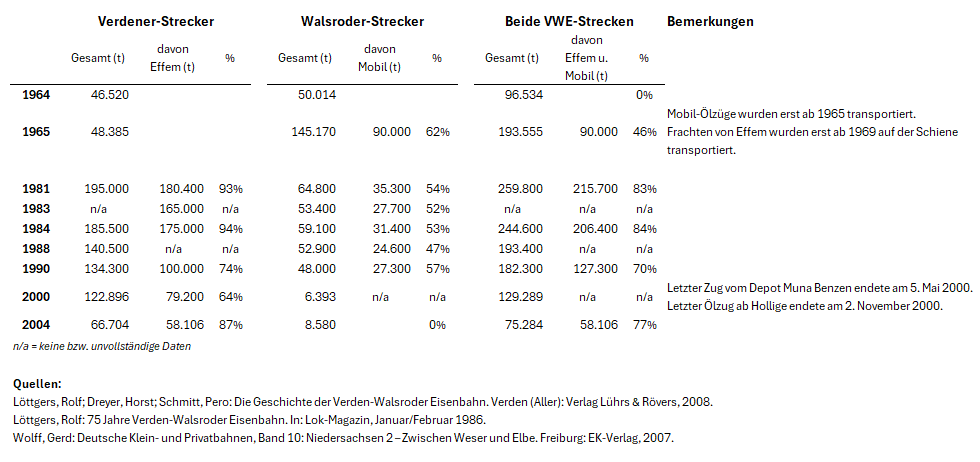
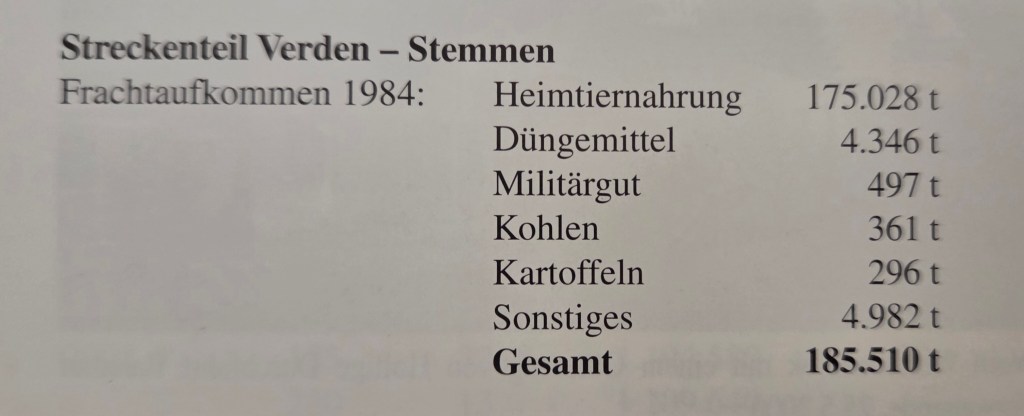
The freight volume in 1984 on the Verden–Stemmen section shows that 94% of the total traffic was generated by Effem GmbH. Source: Gerd Wolff.
Effem’s freight volume was so large that the company operated its own diesel switcher, a Köf II (No. 5231), acquired from Deutsche Bundesbahn (ex DB 323 049-7). This locomotive switched wagons inside the factory and transferred them to Verden (Aller) Süd. Löttgers (2008) reports that this small switcher handled more than 40 freight wagons daily, with six train pairs Monday–Friday and two on Saturdays.
This small historical detail turns out to be far more important for modelling than it first appears. Operationally, Effem behaved almost like a small railway inside the VWE system rather than just a customer siding.
From a modelling perspective, this is the key that makes both solo operation and two-operator operation possible without any change to the timetable logic.
Other traffic—such as fertilisers in spring, military consignments, and coal and potatoes during the autumn harvest period—made up seasonal flows.
Two Operating Modes at Verden Süd
Important for operations on the model: the same RF (Rangierzeitfenster, switching window) windows below work in two modes, depending on how many operators are available.
- Solo mode: one locomotive handles everything (Verden ↔ Verden Süd transfer, yard sorting, and all industry sidings including Effem).
- Two-operator mode: Effem has its own locomotive (Köf) which switchs only within Effem and transfers wagons only between Effem and a defined handover point at Verden Süd, while the VWE locomotive handles everything else (yard work, Freitag, seasonal traffic, and Verden DB transfer). Effem’s loco does not go to DB Verden.
| Task | Solo (1 loco) | Two operators (Effem + VWE) |
|---|---|---|
| Verden ↔ Verden Süd | VWE loco | VWE loco |
| Yard switching | VWE loco | VWE loco |
| Freitag / seasonal / Löbl | VWE loco | VWE loco |
| Effem E1/E2 | VWE loco | Effem Köf only |
| Effem ↔ Track 3 | VWE loco | Effem Köf only |
The remarkable part is that the timetable itself does not change — only who performs which moves changes.
Deep-Diving into the VWE Freight Operations Concept
To understand why the yard behaves the way it does, you first have to understand where the VWE meets the DB.
In this region, the DB main line from Hannover to Bremen (Hannover–Nienburg–Langwedel–Bremen), and the route toward Hamburg (Hannover–Nienburg–Rotenburg–Bremen) connect with the VWE at Verden (Aller).
The interchange at Verden is located about 1.5 km from Verden Süd. Track 6 allows transfers without occupying passenger platform 5. The actual handover occurs on track 105, the infrastructure boundary between DB and VWE.

Understanding this DB–VWE interchange is fundamental, because it directly defines the on-scene flow of VWE freight operations at Verden Süd. The timing, direction and pressure in the yard all originate here.
On the model, this connection is represented off-scene by a fiddle yard or FREMO interchange.
I am very grateful to Markus I. for providing original freight train timetables from 1984/85.
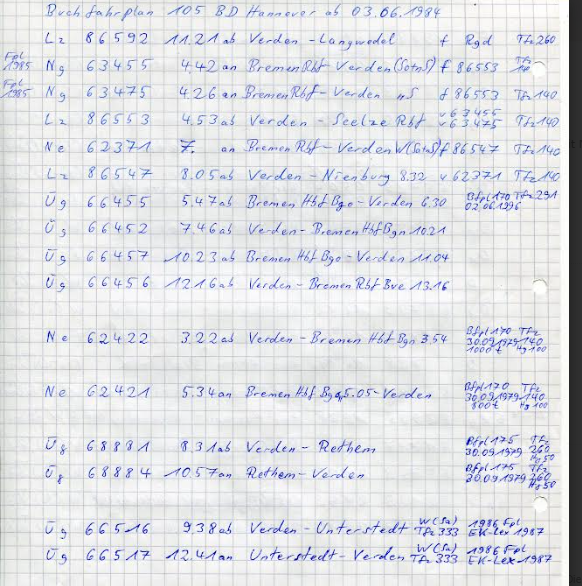
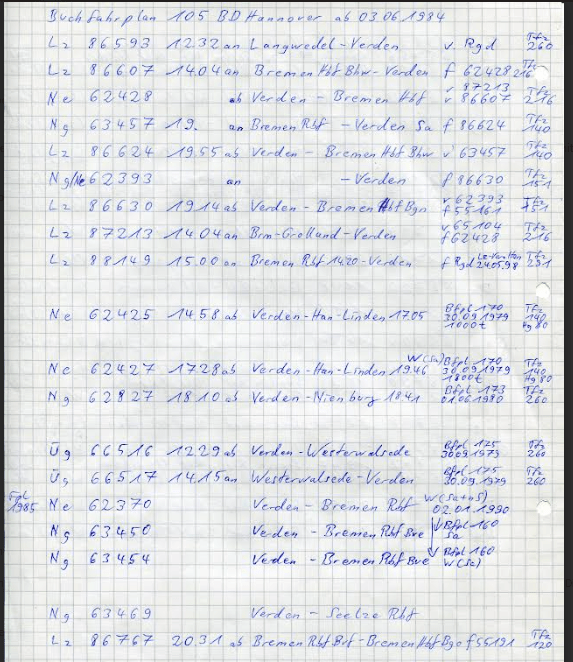
When I started matching these timetables with Effem’s production rhythm, something suddenly clicked for me:
The yard is not busy all day.
It becomes very busy twice a day — and everything revolves around those moments.
Coordinated Working Timetable
DB ↔ VWE – Verden / Verden (Aller) Süd: Epoch IV (1984/85)
Monday – Friday (Core Operation DB ↔ VWE Interchange Trains — Scheduled Runs)
These four DB trains create the entire day at Verden Süd.
| Time at Verden | Train | Direction | Purpose | Dispatcher / Shunter Focus |
|---|---|---|---|---|
| ~06:30 | Üg 66455 | Bremen Hbf Bgo → Verden | Early inbound | Inbound Gbs empties, Ucs loaded wagons must be distributed immediately |
| ~07:46 | Üg 66452 | Verden → Bremen Hbf Bgo | Early outbound | First outbound window — early Effem production leaves |
| ~11:04 | Üg 66457 | Bremen Hbf Bgo → Verden | Late-morning inbound | Second inbound wave — balancing and Freitag supply |
| ~12:16 | Üg 66456 | Verden → Bremen Rbf | Main outbound | Main outbound window — bulk of production leaves |
- Morning supply and early pickup (06:30–07:45)
- Late-morning balancing and main pickup (11:04–12:16)
Saturday (Reduced, Clearance-focused DB ↔ VWE Interchange Trains — Scheduled Runs)
| Time at Verden | Train | Direction | Purpose | Notes |
|---|---|---|---|---|
| ~06:30 | Üg 66455 | Bremen Hbf Bgo → Verden | Inbound Gbs empties wagons | Only if required (Effem / Monday prep) |
| ~07:46 | Üg 66452 | Verden → Bremen Hbf Bgo | Main outbound | Clears remaining production |
| ~09:38 | Üg 66516 | Verden → Unterstedt | Seasonal outbound | On demand only |
| ~12:41 | Üg 66517 | Unterstedt → Verden | Seasonal return | Stemmen traffic only |
Saturday operations at VWE are primarily intended to clear remaining wagons from the week, remove unnecessary empties before Monday’s inbound traffic, and handle seasonal movements where required.
In two-operator mode, Saturday remains “VWE-led”: Effem’s loco may still shuffle within Effem and feed/collect at the handover point, but only the VWE locomotive transfers to DB Verden.
Their timing aligns naturally with Effem’s production rhythm and provides suitable windows for serving other industries such as Hans Freitag and seasonal traffic.
One Operating Philosophy
DB Sets the Clock,
Effem Determines the Priority,
VWE Keeps the Flow
Operating Locations
Before looking at individual tracks, it helps to picture what a typical day actually looks like in the yard. That picture is defined by the RF phases below.
Operations are centred on Verden (DB) (off-scene, fiddle yard), which acts as the interchange point with the Verden–Walsrode Railway (VWE). The actual switching and local freight operations take place at Verden Süd (VWE), which functions as the VWE’s shunting and interchange yard.
What is easy to overlook here is that two different “railways” operate in this space: the VWE yard locomotive and Effem’s own Köf.
Track Layout – Verden Süd (Lengths and Functions)
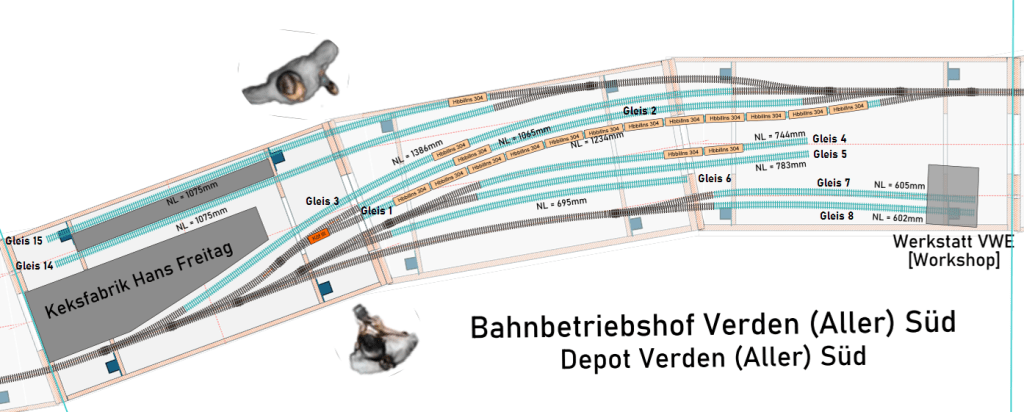
First rendition of the detailed view of the depot area at Verden (Aller) Süd, showing track numbers and usable track lengths.
Erste Version der detaillierten Ansicht des Depotbereichs in Verden (Aller) Süd mit Gleisnummern und nutzbaren Gleislängen.
At Verden Süd, freight operations are spread across six tracks, each with a clearly defined role:
| Track | Usable length | Function |
|---|---|---|
| Track 1 | 1230 mm | Outbound pickup track – empties/loaded wagons, ready for transfer to DB |
| Track 2 | 1064 mm | Through and runaround track – must be kept clear for locomotive movements |
| Track 3 | 1386 mm | Arrival and distribution track for all newly arrived wagons; in two-operator mode also the defined Effem handover point |
| Track 4 | 774 mm | Primarily for the Löbl scrap dealer and open wagons |
| Track 5 | 780 mm | Seasonal and special traffic (e.g. Luttum, Armsen); can also serve as a buffer for Stemmen traffic |
| Track 6 | 690 mm | Rare and sensitive traffic (Badenhop/Heibo, military consignments) |
Track 3 is the operational key: this is where the two “railways” physically meet on the model.
Additionally:
- Track 7 is used for refuelling and stabling diesel locomotives.
- Track 8 is reserved for repair and maintenance work.
Production Cycles and Their Influence on Transfers
Effem – Continuous Early-Shift Production
By the 1980s, Effem had become a major producer of dry and canned pet food, which explains the heavy daily rhythm of inbound raw materials and outbound finished goods. That rhythm is what drives the rail traffic.
| Shift | Approx. Time | Effect on Rail Traffic |
|---|---|---|
| Early shift | ~05:30–13:30 | Main production output |
| Late shift | ~13:30–21:00 | Reduced output, mostly for next day |
| Night | No production | No rail relevance |
The early shift is decisive for rail operations. As production ramps up shortly after 06:00, a steady flow of finished products begins to accumulate in the loading sidings. At the same time, empty wagons are urgently required to keep the loading points free.
Effem has two dedicated sidings:
| Track | Length | Function | Typical wagons |
|---|---|---|---|
| E1 | 668 mm | Bulk traffic | Ucs / Uaoos |
| E2 | 668 mm | General cargo | Gbs / Tms |
This is what gives Effem both the direction and the urgency of the shunting work: first supply empties, then immediately remove loaded wagons.
Hans Freitag – Batch-Oriented Production
Freitag’s importance is not volume, but timing. Its batch loading fits into the gaps created by Effem’s dominance.

The Hans Freitag biscuit factory follows a very different rhythm. Production is batch-based rather than continuous, and rail loading is not tied to a strict shift boundary.
| Activity | Approx. Time | Effect on Rail Traffic |
|---|---|---|
| Morning production | ~07:00–10:30 | No immediate rail need |
| Packaging & storage | ~10:30–12:30 | Wagons begin to be loaded |
| Afternoon | Variable | Often no rail activity |
Freitag is a regular secondary customer served by two long sidings:
| Track | Length | Function | Capacity |
|---|---|---|---|
| F1 | 1075 mm | Inbound | Up to 10 wagons |
| F2 | 1075 mm | Outbound | Up to 10 wagons |
A realistic operating pattern here is two services on weekdays and zero to one on Saturdays.
Badenhop / Heibo
Rail traffic here is extremely rare, but operationally useful as a buffer siding directly opposite Effem.
Located directly opposite Effem, with Effem as its principal customer, Badenhop’s rail siding exists primarily to support just-in-sequence deliveries and occasional loaded or empty freight movements, rather than to generate regular wagon flows of its own.
| Track | Length | Capacity | Traffic level |
|---|---|---|---|
| Badenhop / Heibo | 480 mm | 4–5 wagons | Fewer than 5 wagons per year |
In regular terms, almost nothing moves here. However, as a special operating rule, Effem may temporarily use this track as a buffer for empty or loaded wagons (maximum four wagons at any time).
That is exactly what makes this siding so valuable from a modelling perspective.
Other rare or seasonal customers
| Customer | Type of traffic | Frequency |
|---|---|---|
| Löbl (scrap dealer) | Open wagons | Rare |
| Luttum | Potatoes (autumn) | Seasonal |
| Armsen (carton factory) | General cargo | Rare |
| Stemmen (Raiffeisen silos) | Agricultural traffic | Seasonal |
Wagon Types
Several standard wagon types are used in the freight traffic handled on this module.
| Wagon Type | Description | Typical Use / Industries |
|---|---|---|
| Ucs / Uaoos | Bulk goods wagons | Effem; Stemmen (grain, feed, fertilizer) |
| Gbs | Covered wagons | Effem, Hans Freitag, Armsen, military traffic |
| Tms | Large covered wagons | Effem, Hans Freitag (rare, high-volume loads) |
| Omm / Eanos | Open wagons | Löbl (scrap traffic) |
| Stake wagons | Open wagons with stakes | Machinery and special loads (very rare) |
VWE Shunting and Interchange Transfer
This is where timetable, yard, industries and operators finally come together into one operating picture.
Monday–Friday (Core Operation)
On weekdays, the interchange transfers follow the production rhythms and the distribution schedules of the customers. Finished products are forwarded to Bremen, where they are transferred to other trains or to road transport for nationwide distribution and export.
| Time Window (VS) | RF | Related DB Slot | Trigger / Dependency | Main Tasks | Must Be Completed By |
|---|---|---|---|---|---|
| 06:00–06:30 | — | Slot A (prep) | Before Üg 66455 arrival | Prepare Verden Süd: clear Track 2, prepare Track 3, position shunting loco | 06:30 |
| ~06:30 | — | Slot A | Üg 66455 arrival | Standby to cut and transfer inbound wagons | — |
| 06:40–06:55 | — | Slot A | After Üg 66455 arrival (~06:30) | Transfer inbound wagons Verden → Verden Süd | 06:55 |
| 06:55–08:10 | RF-A | Slot A | Inbound wagons on Track 3 | Distribute empties to Effem, Freitag, seasonal tracks | — |
| 06:55–07:25 | RF-B | Slot B | Before Üg 66452 departure (~07:45) | Assemble early outbound cut on Track 1 (Effem priority) | 07:30 (wagons must leave Verden Süd) |
| 07:30–07:45 | — | Slot B | Before DB departure | Transfer outbound cut Verden Süd → Verden, couple & brake test | 07:45 |
| ~07:45 | — | Slot B | Üg 66452 departure | Shunting loco returns to Verden Süd | — |
| 10:34–11:04 | — | Slot C (prep) | Before Üg 66457 arrival | Prepare Verden Süd: clear Track 2, prepare Track 3, position shunting loco | 11:04 |
| ~11:04 | — | Slot C | Üg 66457 arrival | Standby to cut and transfer inbound wagons | — |
| 11:05–11:20 | — | Slot C | After Üg 66457 arrival (~11:04) | Transfer inbound wagons Verden → Verden Süd | 11:20 |
| 11:20–12:10 | RF-C | Slot C | Inbound wagons on Track 3 | Serve Hans Freitag, balance Effem, handle seasonal wagons | — |
| 11:20–11:55 | RF-D | Slot D | Before Üg 66456 departure (~12:16) | Assemble main outbound block on Track 1 (bulk Effem, Freitag) | 11:55 (wagons must leave Verden Süd) |
| 11:55–12:10 | — | Slot D | Before DB departure | Transfer outbound cut Verden Süd → Verden, couple & brake test | 12:10 |
| ~12:16 | — | Slot D | Üg 66456 departure | Shunting loco returns to Verden Süd | — |
| 12:30–15:00 | — | Post Slot D | After Üg 66456 | Yard tidying, accumulation, next-day preparation |
Priority rule: Outbound assembly (RF-B and RF-D) always overrides inbound distribution if conflicts arise.
Two-operator interpretation: throughout all RF phases, VWE works only the Track 3 handover point, and the Effem Köf works only E1/E2.
Saturday (Reduced, Clearance-Focused)
Saturday uses the same logic, but without production pressure. It is primarily a clearing and preparation day.
| Time Window (VS) | RF | Related Train | Trigger / Dependency | Main Tasks | Must Be Completed By |
|---|---|---|---|---|---|
| 06:00–06:30 | — | Üg 66455 (if runs) | Before inbound | Prepare Track 3, clear Track 2 | 06:30 |
| 06:30–07:15 | RF-Sa-A | Üg 66455 | After inbound empties arrival | Distribute empties only if required | 07:30 |
| 07:15–07:45 | RF-Sa-B | Üg 66452 | Before main outbound | Assemble outbound cut on Track 1 | 07:45 |
| 07:45–08:00 | — | Üg 66452 | Before DB departure | Transfer outbound cut Verden Süd → Verden | 08:00 |
| 09:30–10:45 | RF-Sa-C | Üg 66517 | After seasonal inbound | Transfer Stemmen return wagons to Verden Süd | 11:00 |
| 10:00–11:30 | RF-Sa-D | Üg 66516 | Before seasonal outbound | Assemble and dispatch Stemmen traffic | 12:00 |
| After 11:30 | — | — | Post-operations | Yard reset, Monday preparation | — |
VWE “Last Mile ” Transfers: Verden Süd ↔ Industries
Monday–Friday (Core, aligned to RF-A…RF-D)
Industry tracks are served by switching movements rather than by separate timetable trains. The work follows two distinct waves during the day: a morning phase of supply and first pickup driven by Slots A and B, and a late-morning phase of additional supply and the main pickup driven by Slots C and D.
When yard capacity becomes tight, the priority rule is always the same: Effem first, Freitag second, everything else last.
RF-A (06:55–08:10) — “Supply Wave”
Goal: get empties into Effem before production peaks.
Outcomes: Effem is supplied with empties. Track 3 is reduced. Any early loaded wagons are staged for RF-B.
| Priority | Destination | Typical Moves | Notes |
|---|---|---|---|
| 1 | Effem E1/E2 | Spot empties, pull any “overnight loaded” | Effem dominates; keep it flowing |
| 2 | Hans Freitag F1 | Spot inbound wagons (ingredients/packaging) | Only if present on Track 3 |
| 3 | Seasonal buffer (Track 5) | Park Stemmen/Luttum/Armsen wagons | Don’t block core tracks |
| 4 | Badenhop / Heibo (or Track 6) | Only if needed / as Effem buffer | Max 1–2 wagons if used |
| 5 | Löbl (Track 4) | Optional spot | Scrap is low priority |
RF-B (06:55–07:25) — “Early Pickup Assembly”
Goal: build the outbound cut for Üg 66452.
Outcome: Track 1 contains the early outbound block, ready to leave Verden Süd by 07:30.
| Action | Source | Destination | Notes |
|---|---|---|---|
| Pull loaded wagons | Effem E1/E2 | Track 1 | Effem only unless something is urgent |
| Pull urgent loaded | Hans Freitag F2 (rare) | Track 1 | Only if already ready |
| Keep Track 2 clear | — | — | No exceptions |
RF-C (11:20–12:10) — “Balancing & Batch Service Wave”
Goal: serve batch-oriented customers and prepare remaining production for the main outbound wave.
Outcomes: Hans Freitag outbound wagons are ready. Effem production is largely staged. Track 3 is partially cleared but not necessarily empty.
RF-C is interruptible. If outbound assembly (RF-D) needs the shunting loco or Track 1 access, RF-C pauses immediately.
| Priority | Destination | Typical Moves | Notes |
|---|---|---|---|
| 1 | Hans Freitag (F1 / F2) | Spot inbound wagons, pull loaded outbound | Core RF-C customer |
| 2 | Effem E1/E2 | Spot additional empties, pull loaded wagons | Balance production peak |
| 3 | Seasonal industries (Luttum, Armsen, Stemmen buffer) | Spot or rearrange wagons | Only if yard capacity allows |
| 4 | Badenhop / Heibo | Spot or hold wagons | May be used as Effem buffer (max. 2 wagons) |
| 5 | Löbl (scrap) | Pull accumulated wagons | Only if time permits |
RF-D (11:20–11:55) — “Main Pickup Assembly”
Goal: assemble the main outbound block for Üg 66456.
Outcomes: Track 1 holds the complete outbound cut. Industry sidings are left with only in-process wagons.
| Action | Source | Destination | Notes |
|---|---|---|---|
| Pull bulk output | Effem E1 (bulk) | Track 1 | Absolute priority |
| Pull bagged feed | Effem E2 | Track 1 | As available |
| Pull loaded wagons | Hans Freitag F2 | Track 1 | If ready by cutoff |
| Pull seasonal wagons | Track 5 / industry | Track 1 | Only if ordered |
| Leave non-ready wagons | Any industry | Remain spotted | Wait for next day |
After RF-D (12:10 onward) — “Reset & Accumulation”
Once Üg 66456 has departed and the shunting loco returns to Verden Süd. No fixed priorities apply here; this is low-pressure housekeeping.
| Activity | Purpose |
|---|---|
| Clear Track 3 | Prevent congestion next morning |
| Spot wagons for next day | Especially Effem empties |
| Accumulate scrap (Löbl) | Build economical outbound |
| Stage seasonal traffic | Keep off core tracks |
| Light industry switching | Only if space is tight |
Saturday (Reduced, Clearance-Focused)
On Saturdays there is no production peak at Effem and only one mandatory DB outbound, Üg 66452. Inbound empty wagons are handled only if required, and seasonal traffic is moved only when yard capacity allows.
RF-Sa-A (06:30–07:30) — “Light Supply & Prep”
Triggered by: Üg 66455 (if it runs)
Outcomes: Yard remains loose and flexible. Only essential wagons are spotted
| Priority | Destination | Typical Moves | Notes |
|---|---|---|---|
| 1 | Effem E1 / E2 | Spot empties (if any) | Only if empties arrived |
| 2 | Hans Freitag | Spot inbound wagons (rare) | Only if present |
| 3 | Seasonal buffer (Track 5) | Park wagons | Avoid blocking Track 3 |
| 4 | Badenhop / Heibo | Hold wagons | May be used as buffer |
| 5 | Löbl (scrap) | No action | Not urgent |
RF-Sa-B (07:15–07:45) — “Saturday Clearance Assembly”
Triggered by: Üg 66452 (main outbound)
Cut-off rule: Any wagon not on Track 1 by 07:45 does not leave on Saturday.
| Action | Source | Destination | Notes |
|---|---|---|---|
| Pull loaded wagons | Effem E1 / E2 | Track 1 | Absolute priority |
| Pull loaded wagons | Hans Freitag | Track 1 | Only if already ready |
| Pull seasonal wagons | Track 5 | Track 1 | Only if ordered |
| Leave in-process wagons | Any industry | Remain spotted | Cleared next week |
RF-Sa-C (09:30–10:45) — “Seasonal Handling (Optional)”
Triggered by: Üg 66517 (if it runs)
Rule: If Üg 66517 does not run, RF-Sa-C is skipped.
| Priority | Destination | Typical Moves | Notes |
|---|---|---|---|
| 1 | Seasonal return wagons | Track 5 | From Stemmen |
| 2 | Effem buffer | Badenhop / Heibo | Max. 1–2 wagons |
| 3 | Löbl (scrap) | Track 4 | Only if space needed |
RF-Sa-D (10:00–11:30) — “Seasonal Outbound (Optional)”
Triggered by: Üg 66516 (if it runs)
Cut-off rule: Seasonal wagons must be ready 30 min before departure.
| Action | Source | Destination | Notes |
|---|---|---|---|
| Assemble seasonal outbound | Track 5 | Track 1 | Stemmen only |
| Transfer cut | Track 1 | Verden | Must be ready before departure |
| No mixed traffic | — | — | Do not add Effem wagons |
After 11:30 — “Reset for Monday”
| Activity | Purpose |
|---|---|
| Clear Track 3 | Clean inbound start |
| Spot Monday empties | Effem priority |
| Accumulate scrap | Efficient next-week pickup |
| Park wagons off core tracks | Free Tracks 1–3 |
Conclusion
From the breakdown of schedules and rationale above, I now have a much clearer understanding of the freight operations. This helps me discuss with FREMO planners how to incorporate my freight requirements into their working timetable.
What started as historical research turned into a complete operating philosophy for the module.
What I particularly like is that the same timetable can feel completely different depending on whether I run it as a one-person “do everything” job, or as a proper two-loco setup where Effem behaves like its own little railway feeding the VWE yard.
References:
Löttgers, Rolf; Dreyer, Horst; Schmitt, Pero: Die Geschichte der Verden-Walsroder Eisenbahn. 2008, Verden (Aller): Verlag Lührs & Rövers, ISBN 978-3-000251-26-9
Löttgers, Rolf: 75 Jahre Verden-Walsroder Eisenbahn. In: Lok-Magazin, Januar/Februar 1986, ISBN 0458-1822-1986 Nr. 136, S. 1-80
Wolff, Gerd: Deutsche Klein- und Privatbahnen, Band 10: Niedersachsen 2 – Zwischen Weser und Elbe, 2007, Freiburg: EK-Verlag, ISBN 978-3-882556-69-8
DEUTSCHE VERSION
Verden–Walsroder (VWE): Fracht-Betriebskonzept
Hinweis: Dies ist der Auftakt zu einer Reihe über mein erstes FREMO-Modul in Spur N nach N-RE-Norm. Es geht mir hier nicht darum, die Geschichte vollständig nachzuerzählen, sondern zu zeigen, was ich recherchiert habe – und wie genau das meine Planung, meinen Bau und später meinen Betrieb beeinflusst.
Kurzer Rückblick
Was ich zu Beginn dieses Projekts ehrlich gesagt noch gar nicht richtig auf dem Schirm hatte: Das Vorbild in Verden Süd eignet sich ganz von selbst für zwei ganz unterschiedliche Betriebsarten. Entweder macht ein einzelner Bediener alles allein – oder mehrere Mitspieler übernehmen jeweils „ihre“ Bahn und arbeiten gemeinsam im selben Bahnhof.
Meine deutliche Vorliebe für ein frachtbetriebsorientiertes Modul dürfte inzwischen klar erkennbar sein. Genau dieser Ansatz passt hervorragend zu FREMO-Treffen, wo der Schwerpunkt stark auf Güterverkehr liegt – typischerweise in Epoche III oder IV, aber problemlos anpassbar bis in Epoche V oder VI. Mit ein paar zusätzlichen Modulstücken lässt sich das Ganze außerdem genauso gut als Heimanlage nutzen.
Zum Hintergrund verweise ich auf meine früheren Beiträge zur Geschichte der Verden–Walsroder Eisenbahn und zum ersten Gleisplankonzept. Hier geht es jetzt darum, was ich gelernt habe, als ich angefangen habe, die Vorbildfakten in einen tatsächlichen Betriebstag zu übersetzen. Der Gleisplan selbst wird sich dabei sicher noch weiterentwickeln – durch Rückmeldungen anderer Modellbahner und durch sich ändernde Anforderungen.
Um zu verstehen, warum das für das Modell so entscheidend ist, muss man sich erst anschauen, was den Güterverkehr in Verden Süd in den 1980ern wirklich dominiert hat.
Was passierte in den 1980ern tatsächlich in Verden Süd?
VWE-Güteraufkommen in den 1980ern
In meinem ersten Beitrag zur Geschichte der Verden–Walsroder Eisenbahn habe ich beschrieben, wie das Rangieren für die Industriebetriebe entlang der Strecken nach Verden und Walsrode praktisch die Lebensversicherung dieser kleinen Privatbahn war.
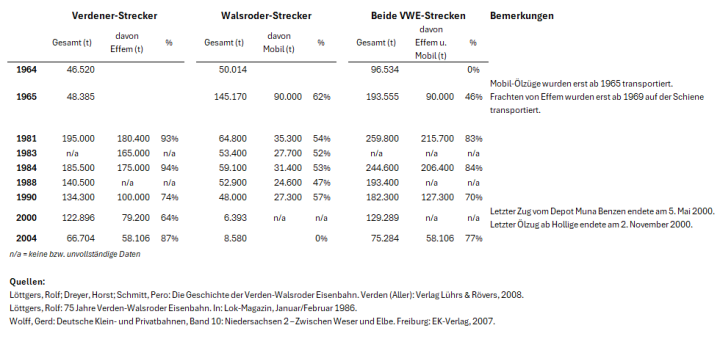
Das Güteraufkommen 1984 auf dem Abschnitt Verden–Stemmen zeigt: 94 % des gesamten Verkehrs wurde von der Effem GmbH erzeugt. Quelle: Gerd Wolff.
Ein Blick auf das Güteraufkommen 1984 auf dem Abschnitt Verden–Stemmen zeigt sehr deutlich, wie extrem sich das verteilt hat: 94 % des gesamten Verkehrs gingen auf das Konto der Effem GmbH.
Effem hatte ein so großes Transportvolumen, dass die Firma sogar eine eigene Rangierlok einsetzte – eine Köf II mit der Nummer 5231, übernommen von der Deutsche Bundesbahn (ex DB 323 049-7). Diese Lok rangierte die Wagen im Werk und überführte sie nach Verden (Aller) Süd.
Löttgers (2008) schreibt, dass dieser kleine Rangierer täglich mehr als 40 Güterwagen bewegte. Montags bis freitags gab es sechs Zugpaare, samstags immerhin noch zwei.
Und genau dieses kleine historische Detail ist für das Modell plötzlich viel wichtiger, als es auf den ersten Blick wirkt.
Betrieblich betrachtet war Effem nämlich fast schon eine kleine „Eisenbahn in der Eisenbahn“ innerhalb des VWE-Systems – und eben nicht einfach nur ein gewöhnlicher Gleisanschlusskunde.
Und genau das ist aus Modellbahnsicht der Schlüssel: Dadurch werden sowohl Einmann-Betrieb als auch Zwei-Bediener-Betrieb möglich, ohne dass sich an der Fahrplanlogik irgendetwas ändern muss.
Der restliche Verkehr – Dünger im Frühjahr, Militärtransporte sowie Kohle und Kartoffeln zur Herbsternte – lief dagegen eher saisonal.
Zwei Betriebsarten in Verden Süd
Für den Betrieb auf dem Modul ist entscheidend: Dieselben Rangierzeitfenster (RF) funktionieren in zwei unterschiedlichen Betriebsarten – je nachdem, wie viele Bediener gerade zur Verfügung stehen.
- Solo-Betrieb: Eine Lok erledigt alles. Übergabe Verden ↔ Verden Süd, Rangieren im Bahnhof und Bedienung sämtlicher Anschlüsse inklusive Effem.
- Zwei-Bediener-Betrieb: Effem hat seine eigene Lok (Köf) und rangiert ausschließlich innerhalb des Werks. Diese Lok übergibt Wagen nur zwischen Effem und einem fest definierten Übergabepunkt in Verden Süd. Die VWE-Lok übernimmt alles andere: Bahnhof, Freitag, saisonale Verkehre und die Übergabe nach DB Verden.
Die Effem-Lok fährt nicht nach DB Verden.
| Aufgabe | Solo (1 Lok) | Zwei Bediener (Effem + VWE) |
|---|---|---|
| Verden ↔ Verden Süd | VWE-Lok | VWE-Lok |
| Rangieren im Bahnhof | VWE-Lok | VWE-Lok |
| Freitag / saisonal / Löbl | VWE-Lok | VWE-Lok |
| Effem E1 / E2 | VWE-Lok | nur Effem-Köf |
| Effem ↔ Gleis 3 (Übergabe) | VWE-Lok | nur Effem-Köf |
Das eigentlich Bemerkenswerte daran: Am Fahrplan selbst ändert sich nichts. Es ändert sich nur, wer welche Fahr- und Rangierbewegungen ausführt.
Das VWE-Güterkonzept im Detail verstehen
Um zu verstehen, warum sich der Bahnhof betrieblich so verhält, wie er es tut, muss man zuerst begreifen, wo die VWE überhaupt auf die DB trifft.
In dieser Region kreuzen sich die DB-Hauptstrecke von Hannover nach Bremen (Hannover–Nienburg–Langwedel–Bremen) sowie die Relation Richtung Hamburg (Hannover–Nienburg–Rotenburg–Bremen) mit der Verden–Walsroder Eisenbahn in Verden (Aller).
Die Übergabestelle liegt rund 1,5 km von Verden Süd entfernt. Über Gleis 6 können Übergaben stattfinden, ohne die Personenbahnsteige zu blockieren. Die eigentliche infrastrukturelle Schnittstelle zwischen DB und VWE ist Gleis 105 – genau dort findet die Wagenübergabe statt.
Dieses DB↔VWE-Übergabeverhältnis ist der eigentliche Taktgeber für alles, was in Verden Süd passiert: Timing, Fahrtrichtung, Rangierintensität – all das hat hier seinen Ursprung.
Auf dem Modell wird diese Verbindung „off-scene“ durch einen Fiddle Yard bzw. eine FREMO-Übergabestelle dargestellt.
Ein großer Dank geht an Markus I., der mir originale Güterzugfahrpläne aus 1984/85 zur Verfügung gestellt hat.
Als ich diese Fahrpläne dann mit dem Produktionsrhythmus von Effem abgeglichen habe, ist mir plötzlich ein Licht aufgegangen:
Der Bahnhof ist nicht den ganzen Tag über gleichmäßig beschäftigt.
Er wird zweimal am Tag extrem intensiv genutzt – und alles dreht sich genau um diese beiden Zeitfenster.
Koordinierter Arbeitsfahrplan
DB ↔ VWE – Verden / Verden (Aller) Süd: Epoche IV (1984/85)
Montag–Freitag
(Kernbetrieb DB ↔ VWE (planmäßige Übergaben)
Mir wurde erst beim Durcharbeiten der Unterlagen klar: Diese vier DB-Züge strukturieren den kompletten Tag in Verden Süd. Nicht der Bahnhof bestimmt den Rhythmus – die Übergaben aus Verden tun es.
| Zeit in Verden | Zug | Richtung | Zweck | Fokus für Fdl / Rangierer |
|---|---|---|---|---|
| ~06:30 | Üg 66455 | Bremen Hbf Bgo → Verden | Frühe Zuführung | Ankommende Leere sofort verteilen |
| ~07:46 | Üg 66452 | Verden → Bremen Hbf Bgo | Frühe Abfuhr | Erstes Ausfuhrfenster – frühe Effem-Produktion geht raus |
| ~11:04 | Üg 66457 | Bremen Hbf Bgo → Verden | Späte Zuführung | Zweite Eingangswelle – Ausgleich & Versorgung Freitag |
| ~12:16 | Üg 66456 | Verden → Bremen Rbf | Hauptabfuhr | Hauptausfuhrfenster – Großteil der Produktion verlässt den Bahnhof |
- 06:30–07:45 → Versorgung am Morgen & frühe Abholung
- 11:04–12:16 → Ausgleichen am späten Vormittag & Hauptabholung
Samstag
Reduzierter, räumender Betrieb DB ↔ VWE (planmäßige Übergaben)
| Zeit in Verden | Zug | Richtung | Zweck | Hinweise |
|---|---|---|---|---|
| ~06:30 | Üg 66455 | Bremen Hbf Bgo → Verden | Leere Wagen | Nur bei Bedarf (Effem / Vorbereitung Montag) |
| ~07:46 | Üg 66452 | Verden → Bremen Hbf Bgo | Hauptabfuhr | Räumt Restproduktion ab |
| ~09:38 | Üg 66516 | Verden → Unterstedt | Saisonabfuhr | Nur bei Bedarf |
| ~12:41 | Üg 66517 | Unterstedt → Verden | Saisonrücklauf | Nur Stemmen-Verkehr |
Der Samstag dient bei der VWE vor allem dazu, die Woche „sauber“ zu beenden: Restwagen raus, unnötige Leere entfernen, Platz schaffen für den Montagsverkehr – und bei Bedarf saisonale Bewegungen abwickeln.
Im Zwei-Bediener-Modus bleibt der Samstag klar VWE-geführt: Die Effem-Köf darf intern rangieren und am Übergabepunkt bereitstellen oder übernehmen, aber nur die VWE-Lok fährt zur DB nach Verden.
Die Zeiten passen dabei ganz natürlich zum Produktionsrhythmus von Effem und öffnen nebenbei passende Fenster für andere Anschließer wie Hans Freitag sowie für saisonale Verkehre.
Eine Betriebsphilosophie
Die DB gibt den Takt vor,
Effem bestimmt die Priorität,
die VWE hält den Fluss aufrecht.
Betriebsstellen
Bevor man sich einzelne Gleise anschaut, hilft es enorm, sich einen typischen Betriebstag im Bahnhof bildlich vorzustellen. Genau dieses Bild wird durch die oben genannten RF-Phasen definiert.
Zentrum des Geschehens ist Bahnhof Verden (Aller) (DB, off-scene im Fiddle Yard), der als Übergabepunkt zur Verden–Walsroder Eisenbahn dient. Das eigentliche Rangieren und der Überganggüterverkehr finden in Verden Süd (VWE) statt, das betrieblich als Rangier- und Übergabebahnhof der VWE fungiert.
Was man dabei leicht übersieht: Hier arbeiten faktisch zwei „Bahnen“ im selben Raum – die VWE-Rangierlok und Effems eigene Köf.
Gleisanlage – Verden Süd (Längen und Funktionen)
Erste Ausarbeitung der detaillierten Ansicht des Depotbereichs in Verden (Aller) Süd mit Gleisnummern und nutzbaren Gleislängen.
In Verden Süd verteilt sich der Güterbetrieb auf sechs Gleise mit klarer Aufgabenverteilung:
| Gleis | Nutzlänge | Funktion |
|---|---|---|
| Gleis 1 | 1230 mm | Abholgleis – ausschließlich beladene Wagen zur Übergabe an die DB |
| Gleis 2 | 1064 mm | Durchgangs- und Umfahrgleis – muss für Lokbewegungen frei bleiben |
| Gleis 3 | 1386 mm | Ankunfts- und Verteilgleis für alle neu eintreffenden Wagen; im Zwei-Bediener-Modus zugleich definierter Effem-Übergabepunkt |
| Gleis 4 | 774 mm | Vorrangig für Schrotthändler Löbl und offene Wagen |
| Gleis 5 | 780 mm | Saison- und Sonderverkehre (u. a. Luttum, Armsen), ggf. Puffer für Stemmen |
| Gleis 6 | 690 mm | Seltene und sensible Verkehre (Badenhop/Heibo, Militär) |
Gleis 3 ist dabei der betriebliche Schlüsselpunkt: Hier treffen sich die beiden „Bahnen“ physisch auf dem Modell.
Zusätzlich:
- Gleis 7 dient zum Tanken und Abstellen der Dieselloks.
- Gleis 8 ist für Reparatur- und Wartungszwecke vorgesehen.
Produktionszyklen und ihr Einfluss auf die Übergaben
Mir wurde erst beim Abgleich von Schichtzeiten und Übergabefenstern klar: Nicht der Fahrplan erzeugt den Druck im Bahnhof – die Produktion bei Effem tut es. Der Fahrplan reagiert darauf.
Effem – durchgehende Frühschichtproduktion
In den 1980ern war Effem ein großer Hersteller von Trocken- und Dosenfutter. Genau daraus entsteht dieser harte tägliche Rhythmus aus Rohstoffzufuhr und Fertigwarenabfuhr – und der treibt den Bahnverkehr.
| Schicht | ca. Zeit | Auswirkung auf den Bahnverkehr |
|---|---|---|
| Frühschicht | ~05:30–13:30 | Hauptproduktionsmenge |
| Spätschicht | ~13:30–21:00 | Geringere Menge, eher Vorbereitung für den Folgetag |
| Nacht | – | Keine Relevanz für die Bahn |
Entscheidend ist die Frühschicht. Kurz nach 06:00 läuft die Produktion hoch, und an den Ladestraßen sammelt sich kontinuierlich Fertigware. Gleichzeitig werden dringend leere Wagen benötigt, damit die Ladepunkte frei bleiben.
Effem besitzt zwei eigene Anschlussgleise:
| Gleis | Länge | Funktion | Typische Wagen |
|---|---|---|---|
| E1 | 668 mm | Massengut | Ucs / Uaoos |
| E2 | 668 mm | Stückgut | Gbs / Tms |
Damit gibt Effem betrieblich Richtung und Dringlichkeit vor: Erst Zuführung von Leeren – dann sofortiges Abziehen der Beladenen.
Hans Freitag – batch-orientierte Produktion
Hier ist nicht die Menge entscheidend, sondern das Timing. Freitag füllt genau die Lücken, die Effem übrig lässt.
Die Keksfabrik Hans Freitag arbeitet chargenweise. Die Verladung hängt nicht an einer festen Schichtkante.
| Aktivität | ca. Zeit | Auswirkung auf den Bahnverkehr |
|---|---|---|
| Produktion am Morgen | ~07:00–10:30 | Noch kein unmittelbarer Bahnbedarf |
| Verpackung & Lager | ~10:30–12:30 | Wagen beginnen gefüllt zu werden |
| Nachmittag | variabel | Oft kein Bahnverkehr |
Freitag ist ein regelmäßiger Nebenanschließer mit zwei langen Gleisen:
| Gleis | Länge | Funktion | Kapazität |
|---|---|---|---|
| F1 | 1075 mm | Eingang | bis zu 10 Wagen |
| F2 | 1075 mm | Ausgang | bis zu 10 Wagen |
Plausibel sind hier zwei Bedienungen werktags und null bis eine am Samstag.
Badenhop / Heibo – selten, aber betrieblich extrem nützlich
Direkt gegenüber von Effem gelegen, mit Effem als wichtigstem Kunden, ist dieser Anschluss weniger Verkehrsquelle als betrieblicher Puffer.
| Gleis | Länge | Kapazität | Verkehr |
|---|---|---|---|
| Badenhop/Heibo | 480 mm | 4–5 Wagen | < 5 Wagen/Jahr |
Regelmäßig fährt hier praktisch nichts. Aber als Sonderregel darf Effem dieses Gleis zeitweise als Puffer für leere oder beladene Wagen nutzen (max. vier Wagen).
Genau das macht diesen Anschluss modellbahnerisch extrem wertvoll.
Weitere, seltene oder saisonale Anschließer
| Anschluss | Art des Verkehrs | Häufigkeit |
|---|---|---|
| Löbl (Schrotthandel) | Offene Wagen | selten |
| Luttum | Kartoffeln (Herbst) | saisonal |
| Armsen (Kartonfabrik) | Stückgut | selten |
| Stemmen (Raiffeisen) | Agrarverkehr | saisonal |
Wagengattungen
| Wagentyp | Beschreibung | Typische Verwendung / Anschließer |
|---|---|---|
| Ucs / Uaoos | Silowagen für Schüttgut | Effem, Stemmen (Getreide, Futter, Dünger) |
| Gbs | Gedeckte Wagen | Effem, Hans Freitag, Armsen, Militär |
| Tms | Großraumgedeckte | Effem, Hans Freitag (selten, große Sendungen) |
| Omm / Eanos | Offene Wagen | Löbl (Schrott) |
| Rungenwagen | Offene Wagen mit Rungen | Maschinen, Sonderladungen (sehr selten) |
VWE-Rangieren und Übergabe an die DB
Hier setzt sich für mich alles zu einem Betriebsbild zusammen: Fahrplan, Gleise, Anschließer und Bediener greifen exakt ineinander.
Montag–Freitag (Kernbetrieb)
Unter der Wochentage folgen die Übergaben direkt dem Produktionsrhythmus der Anschließer. Fertigwaren gehen nach Bremen, werden dort auf andere Züge oder den Lkw umgeschlagen und deutschlandweit bzw. ins Ausland verteilt.
Unter der Woche folgen die Übergaben direkt dem Produktionsrhythmus der Anschließer. Fertigwaren gehen nach Bremen, werden dort auf andere Züge oder den Lkw umgeschlagen und deutschlandweit bzw. ins Ausland verteilt.
| Zeitfenster (VS) | RF | DB-Bezug | Auslöser / Abhängigkeit | Hauptaufgaben | Erledigt bis |
|---|---|---|---|---|---|
| 06:00–06:30 | — | Slot A (Vorbereitung) | vor Üg 66455 | Verden Süd vorbereiten: Gleis 2 frei, Gleis 3 bereit, Rangierlok positionieren | 06:30 |
| ~06:30 | — | Slot A | Üg 66455 an | Bereitstehen zum Zerlegen und Übernehmen | — |
| 06:40–06:55 | — | Slot A | nach Ankunft (~06:30) | Wagen Verden → Verden Süd überführen | 06:55 |
| 06:55–08:10 | RF-A | Slot A | Wagen auf Gleis 3 | Leere zu Effem, Freitag und Saison verteilen | — |
| 06:55–07:25 | RF-B | Slot B | vor Üg 66452 (~07:45) | Frühe Abfuhr auf Gleis 1 bilden (Effem zuerst) | 07:30 |
| 07:30–07:45 | — | Slot B | vor DB-Abfahrt | Zugteil VS → Verden, kuppeln, Bremsprobe | 07:45 |
| ~07:45 | — | Slot B | Üg 66452 ab | Rangierlok zurück nach VS | — |
| 10:34–11:04 | — | Slot C (Vorbereitung) | vor Üg 66457 | Gleis 2 frei, Gleis 3 vorbereiten, Lok bereitstellen | 11:04 |
| ~11:04 | — | Slot C | Üg 66457 an | Bereitstehen | — |
| 11:05–11:20 | — | Slot C | nach Ankunft (~11:04) | Wagen Verden → VS überführen | 11:20 |
| 11:20–12:10 | RF-C | Slot C | Wagen auf Gleis 3 | Freitag bedienen, Effem ausgleichen, Saison bewegen | — |
| 11:20–11:55 | RF-D | Slot D | vor Üg 66456 (~12:16) | Hauptabfuhr auf Gleis 1 bilden | 11:55 |
| 11:55–12:10 | — | Slot D | vor DB-Abfahrt | Zugteil VS → Verden, Bremsprobe | 12:10 |
| ~12:16 | — | Slot D | Üg 66456 ab | Rangierlok zurück nach VS | — |
| 12:30–15:00 | — | nach Slot D | — | Aufräumen, Sammeln, Vorbereitung für den nächsten Tag | — |
Prioritätsregel: Die Bildung der Abfuhr (RF-B und RF-D) hat immer Vorrang vor der Verteilung eingehender Wagen.
Zwei-Bediener-Interpretation: Während aller RF-Phasen arbeitet die VWE ausschließlich am Übergabepunkt auf Gleis 3. Die Effem-Köf arbeitet ausschließlich auf E1/E2.
Samstag (reduziert, „Aufräum- und Vorbereitungstag“)
Samstag läuft nach demselben Prinzip, aber ohne Produktionsdruck. Im Kern ist das ein Tag, an dem man Restwagen rausbekommt, Leere reduziert und – falls angesetzt – Saisonverkehr sauber abwickelt.
Der Tag dient vor allem dem Räumen und Vorbereiten.
Am Samstag läuft dieselbe Logik – aber ohne Produktionsdruck. Der Tag dient vor allem dem Räumen und Vorbereiten.
| Zeitfenster (VS) | RF | Zug | Auslöser / Abhängigkeit | Hauptaufgaben | Erledigt bis |
|---|---|---|---|---|---|
| 06:00–06:30 | — | Üg 66455 (falls) | vor Einfahrt | Gleis 3 vorbereiten, Gleis 2 freimachen | 06:30 |
| 06:30–07:15 | RF-Sa-A | Üg 66455 | nach Ankunft der Leeren | Leere nur bei Bedarf verteilen | 07:30 |
| 07:15–07:45 | RF-Sa-B | Üg 66452 | vor Hauptabfuhr | Abfuhrblock auf Gleis 1 bilden | 07:45 |
| 07:45–08:00 | — | Üg 66452 | vor DB-Abfahrt | Zugteil VS → Verden überführen | 08:00 |
| 09:30–10:45 | RF-Sa-C | Üg 66517 | nach Saison-Eingang | Stemmen-Rückläufer nach VS bringen | 11:00 |
| 10:00–11:30 | RF-Sa-D | Üg 66516 | vor Saison-Abfuhr | Stemmen-Verkehr bilden und abfahren | 12:00 |
| ab 11:30 | — | — | Nachlauf | Bahnhof zurücksetzen, Montag vorbereiten | — |
VWE „Letzte Meile“: Verden Süd ↔ Anschließer
Montag–Freitag (Kernbetrieb, ausgerichtet an RF-A…RF-D))
Mir wurde erst beim Durchspielen der RF-Phasen klar: Die Anschlüsse bekommen keine eigenen Züge. Alles passiert rein über Rangierbewegungen – und zwar in zwei klaren Wellen am Tag.
- Morgens: Versorgung und erste Abholung (Slots A und B)
- Später Vormittag: Nachversorgung und Hauptabholung (Slots C und D)
Wenn es im Bahnhof eng wird, gilt immer dieselbe Regel: Effem zuerst, Freitag danach, alles andere zum Schluss.
RF-A (06:55–08:10) — „Versorgungswelle“
Ziel: Leere rechtzeitig zu Effem bringen, bevor die Produktion ihren Höhepunkt erreicht.
Ergebnis: Effem ist versorgt, Gleis 3 wird entlastet, erste beladene Wagen stehen für RF-B bereit.
| Priorität | Ziel | Typische Bewegungen | Hinweise |
|---|---|---|---|
| 1 | Effem E1/E2 | Leere zustellen, „über Nacht Geladene“ abziehen | Effem dominiert – Fluss halten |
| 2 | Hans Freitag F1 | Eingangswagen zustellen (Zutaten/Verpackung) | Nur falls auf Gleis 3 vorhanden |
| 3 | Gleis 5 (Saisonpuffer) | Stemmen/Luttum/Armsen zwischenparken | Kerngleise nicht blockieren |
| 4 | Badenhop / Heibo (oder Gleis 6) | Nur bei Bedarf / als Effem-Puffer | max. 1–2 Wagen |
| 5 | Löbl (Gleis 4) | Optional zustellen | Schrott hat niedrige Priorität |
RF-B (06:55–07:25) — „Frühe Abholung bilden“
Ziel: Zugteil für Üg 66452 auf Gleis 1 bereitstellen.
Ergebnis: Gleis 1 enthält den frühen Abfuhrblock und muss um 07:30 Verden Süd verlassen.
| Aktion | Von | Nach | Hinweise |
|---|---|---|---|
| Beladene Wagen ziehen | Effem E1/E2 | Gleis 1 | Nur Effem, außer es ist etwas wirklich dringend |
| Eilige beladene Wagen | Hans Freitag F2 (selten) | Gleis 1 | Nur wenn bereits fertig |
| Gleis 2 freihalten | — | — | Keine Ausnahmen |
RF-C (11:20–12:10) — „Ausgleich & Chargenbedienung“
Ziel: Chargenanschließer bedienen und restliche Produktion für RF-D vorbereiten.
Ergebnis: Freitag ist abfahrbereit, Effem weitgehend vorgezogen, Gleis 3 teilweise geräumt.
Wichtig: RF-C ist jederzeit unterbrechbar. Sobald RF-D die Lok oder Gleis 1 braucht, stoppt RF-C sofort.
| Priorität | Ziel | Typische Bewegungen | Hinweise |
|---|---|---|---|
| 1 | Hans Freitag (F1/F2) | Zustellen und Abziehen | Kernkunde dieser Phase |
| 2 | Effem E1/E2 | Weitere Leere, Beladene ziehen | Produktionsspitze ausgleichen |
| 3 | Saisonanschließer | Zustellen oder umsetzen | Nur wenn Platz vorhanden |
| 4 | Badenhop/ Heibo | Wagen abstellen oder halten | Effem-Puffer (max. 2 Wagen) |
| 5 | Löbl (Schrott) | Gesammelte Wagen abziehen | Nur wenn Zeit bleibt |
RF-D (11:20–11:55) — „Hauptabholung bilden“
Ziel: Kompletten Zugteil für Üg 66456 auf Gleis 1 zusammenstellen.
Ergebnis: Gleis 1 ist voll, die Anschlüsse bleiben nur mit „in Arbeit befindlichen“ Wagen zurück.
| Aktion | Von | Nach | Hinweise |
|---|---|---|---|
| Massengut abziehen | Effem E1 | Gleis 1 | Absolute Priorität |
| Sackware abziehen | Effem E2 | Gleis 1 | Nach Verfügbarkeit |
| Beladene Wagen | Hans Freitag F2 | Gleis 1 | Nur wenn rechtzeitig fertig |
| Saisonwagen | Gleis 5 / Anschluss | Gleis 1 | Nur auf Anforderung |
| Nicht fertige Wagen | Alle | Bleiben stehen | Gehen erst am nächsten Tag |
Nach RF-D (ab 12:10) – Zurücksetzen & Sammeln
Sobald Üg 66456 draußen ist und die Rangierlok wieder in Verden Süd steht, ist der ganze Zeitdruck wie abgeschnitten. Ab hier gibt es keine Prioritäten mehr. Jetzt geht es nur noch darum, den Bahnhof sauber und stressfrei in den nächsten Tag zu bringen.
Ziel: Lockerer Betrieb ohne feste Rangierprioritäten
Ergebnis: Aufgeräumte Gleise und Vorbereitung für Montag
| Tätigkeit | Zweck |
|---|---|
| Gleis 3 räumen | Stau am nächsten Morgen vermeiden |
| Wagen für morgen zustellen | Vor allem Effem-Leere bereitstellen |
| Schrott sammeln (Löbl) | Wirtschaftliche Abfuhr vorbereiten |
| Saisonwagen parken | Kerngleise 1–3 freihalten |
| Leichte Rangierarbeiten | Nur wenn es betrieblich eng wird |
Im Zwei-Bediener-Betrieb kann Effems Köf hier schon „vorarbeiten“: Leere Richtung Übergabepunkt ziehen, damit der nächste Morgen sofort fließt.
Samstag (reduziert, räumend)
Erst beim Durchspielen des Samstags wurde mir klar: Hier fehlt der Produktionsdruck von Effem völlig. Übrig bleibt im Grunde nur eine Pflichtaufgabe – die Abfuhr mit Üg 66452. Alles andere passiert nur, wenn es wirklich nötig ist oder wenn der Bahnhof es zulässt.
Leere Wagen werden nur behandelt, wenn sie gebraucht werden. Saisonverkehr läuft nur, wenn genug Platz da ist.
RF-Sa-A (06:30–07:30) — „Leichte Versorgung & Vorbereitung“
Auslöser: Üg 66455 (falls er fährt)
Ergebnis: Der Bahnhof bleibt locker und beweglich. Es werden nur unbedingt nötige Wagen zugestellt.
| Priorität | Ziel | Typische Bewegungen | Hinweise |
|---|---|---|---|
| 1 | Effem E1 / E2 | Leere zustellen (falls vorhanden) | Nur wenn Leere angekommen sind |
| 2 | Hans Freitag | Eingangswagen zustellen (selten) | Nur falls auf Gleis 3 |
| 3 | Saisonpuffer (Gleis 5) | Wagen zwischenparken | Gleis 3 nicht blockieren |
| 4 | Badenhop / Heibo | Wagen abstellen | Kann als Puffer dienen |
| 5 | Löbl (Schrott) | Keine Aktion | Nicht dringend |
RF-Sa-B (07:15–07:45) — „Samstags-Abfuhr bilden“
Auslöser: Üg 66452 (Hauptabfuhr)
Stichtagsregel: Was um 07:45 nicht auf Gleis 1 steht, bleibt bis zur nächsten Woche.
| Aktion | Von | Nach | Hinweise |
|---|---|---|---|
| Beladene Wagen ziehen | Effem E1 / E2 | Gleis 1 | Absolute Priorität |
| Beladene Wagen ziehen | Hans Freitag | Gleis 1 | Nur wenn bereits fertig |
| Saisonwagen ziehen | Gleis 5 | Gleis 1 | Nur auf Anforderung |
| Wagen in Arbeit | Alle Anschlüsse | Bleiben stehen | Nächste Woche |
RF-Sa-C (09:30–10:45) — „Saisonbehandlung (optional)“
Auslöser: Üg 66517 (falls er fährt)
Regel: Fällt der Zug aus, entfällt diese Phase komplett.
| Priorität | Ziel | Typische Bewegungen | Hinweise |
|---|---|---|---|
| 1 | Saisonrückläufer | Gleis 5 | Von Stemmen kommend |
| 2 | Effem-Puffer | Badenhop / Heibo | max. 1–2 Wagen |
| 3 | Löbl (Schrott) | Gleis 4 | Nur wenn Platz gebraucht wird |
RF-Sa-D (10:00–11:30) — „Saisonabfuhr (optional)“
Auslöser: Üg 66516 (falls er fährt)
Stichtagsregel: Saisonwagen müssen 30 Minuten vor Abfahrt bereitstehen.
| Aktion | Von | Nach | Hinweise |
|---|---|---|---|
| Saisonabfuhr bilden | Gleis 5 | Gleis 1 | Nur Stemmen |
| Zugteil überführen | Gleis 1 | Verden | Rechtzeitig vor Abfahrt |
| Keine Mischverkehre | — | — | Keine Effem-Wagen beistellen |
Nach 11:30 — „Zurücksetzen für Montag“
| Tätigkeit | Zweck |
|---|---|
| Gleis 3 räumen | Sauberer Start für eingehende Wagen |
| Montags-Leere zustellen | Effem hat Priorität |
| Schrott sammeln | Effiziente Abfuhr nächste Woche |
| Wagen außerhalb der Kerngleise parken | Gleise 1–3 freihalten |
Fazit
Durch das Zerlegen von Fahrplan, Produktionsrhythmus und Rangierlogik ist für mich ein sehr klares Bild des Güterbetriebs entstanden. Damit kann ich jetzt mit den Planern von FREMO konkret besprechen, wie sich diese Anforderungen sauber in einen Arrangement-Fahrplan einfügen lassen.
Was als historische Recherche begann, ist zu einer vollständigen Betriebsphilosophie für das Modul geworden.
Und genau das gefällt mir besonders: Derselbe Fahrplan fühlt sich völlig unterschiedlich an, je nachdem, ob ich allein „alles selbst“ mache oder ob Effem im Zwei-Lok-Betrieb wie eine kleine eigene Bahn arbeitet, die den VWE-Bahnhof füttert.
Literaturhinweise:
Löttgers, Rolf; Dreyer, Horst; Schmitt, Pero: Die Geschichte der Verden-Walsroder Eisenbahn. 2008, Verden (Aller): Verlag Lührs & Rövers, ISBN 978-3-000251-26-9
Löttgers, Rolf: 75 Jahre Verden-Walsroder Eisenbahn. In: Lok-Magazin, Januar/Februar 1986, ISBN 0458-1822-1986 Nr. 136, S. 1-80
Wolff, Gerd: Deutsche Klein- und Privatbahnen, Band 10: Niedersachsen 2 – Zwischen Weser und Elbe, 2007, Freiburg: EK-Verlag, ISBN 978-3-882556-69-8
 germaN:160 by traiNmaster
One thought on “Verden-Walsroder Eisenbahn (VWE): Freight Operations Concept”