
Note to readers: N-scale has often been a misunderstood scale, either new comers not aware of its existence, ignorance or misinformation. Thus, I will write a series of articles on this scale in hope to educate and encourage more adopters. I consider myself a beginner to this hobby although I have done a lot of research, reading and learning and contributing in forums for last 10 years. Please share with others. If you would like to post in your blog, go ahead. If you want to me write about something, please email me.
This is the first of a series of write-up on N-scale (Ngage and Njoy in Nscale):
N#1: What is N-scale?
Arnold Rapido of Germany first introduced N-scale (N stands for “Neun” in Deutsch, or “Nine”) which uses 9mm track gauge to represent the real-world 1435mm standard gauge in 1960. The original scale was 1:200 but was later changed to 1:160 in 1962.
Although 1:160 is a common proportion for N-scale worldwide (US, Continental Europe), there are 2 other variations – 1:148 and 1:150 – both also using the same 9mm track gauge. The 1:148 is used by British modellers due to the different loading gauge on the Isle, while the 1:150 is used by Japanese modellers due to the Japanese narrow (Cape) gauge for their regional and metro trains. For the Japanese high-speed bullet trains, the standard 1:160 is used.
Due to the usage of common 9mm tracks, you can use N-scale train models from any country. In addition, most N-scale train models come with Rapido couplers (also introduced by Arnold Rapido; hence, also the name of the N-scale coupler). It is increasingly common to use knuckle couplers to replace the bulky Rapido couplers and to match closely to the real-life. Micro-Trains US (former sister compay of Kadee) and Dapol UK make knuckle couplers for N-scale. Only Dapol UK has knuckle couplers and adaptors for NEM365 sockets for Continental European N-scale train models.
N-scale is said to be the second most popular scale after HO (Half of O), 1:87.1. Two other scales before and after N-scale are TT-scale (Table Top) 1:120 and Z-scale 1:220 respectively.
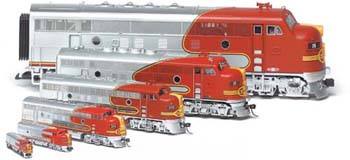
Starting on the left, the smallest locomotive is in Z scale (1:220). Next from the left is N scale (1:160), then HO scale (1:87.1), and S scale (1:64). The next largest locomotive is O scale (1:48) and the largest is in G scale (approximately a 1:29).
 germaN:160 by traiNmaster